Showing posts sorted by relevance for query Bernhard. Sort by date Show all posts

Friday, January 25, 2013

Climbing Mount Mordant/Thomas Bernhard


In German, Bissigkeit, with bissig being viciousness. Mordant.  Mordancy.  As in "The most mordant of writers was Thomas Bernhard."  No cynic, Bernhard could turn a huckster like Sartre to pâté en terrine with a single ten-page sentence.  The rollicking, circling, repetitive, nihilistic, unpackable, Kafkaesque cadences of Bernhard--the only writer apart from Kafka who makes me laugh out loud*--usually end at the same point, the very one Sophocles makes in Oedipus at Colonus (line 1225): "Better never to have been born."  The climax of Bernhard's Yes is an affirmation of suicide, and only the puckish Bernhard, who I would guess loved life in the way all true nihilists do, would write a mad monologue affirming that there is nothing worth affirming, that life is not so much absurd as horrifying, that no human act could have value, and that, nonetheless, the whole  affair is best understood not as tragedy but as farce. 

It would be coy to say that Bernhard was the great chronicler of our era; he wasn't, and such a notion  would have left him in stitches.  He was of no era, or perhaps he was of the greatest of centuries, the sixteenth, when wit and murder danced an allemande with plague and famine.  Moving through a typical blasted Bernhard landscape is like being parachuted into the milieu of Matthias Grünewald, perhaps into one of the panels of his Crucifixion, a world in which cruelty was seasoned with decorum--no anonymous drones dropping bombs in Grünewald; the lashes were applied by a man, whose grotesque mask seems to say--"Well, what can I do?"  As in Bernhard, the Old Masters were never mistaken about the causes and nature of suffering, and Icarus lands with an indifferent splash.
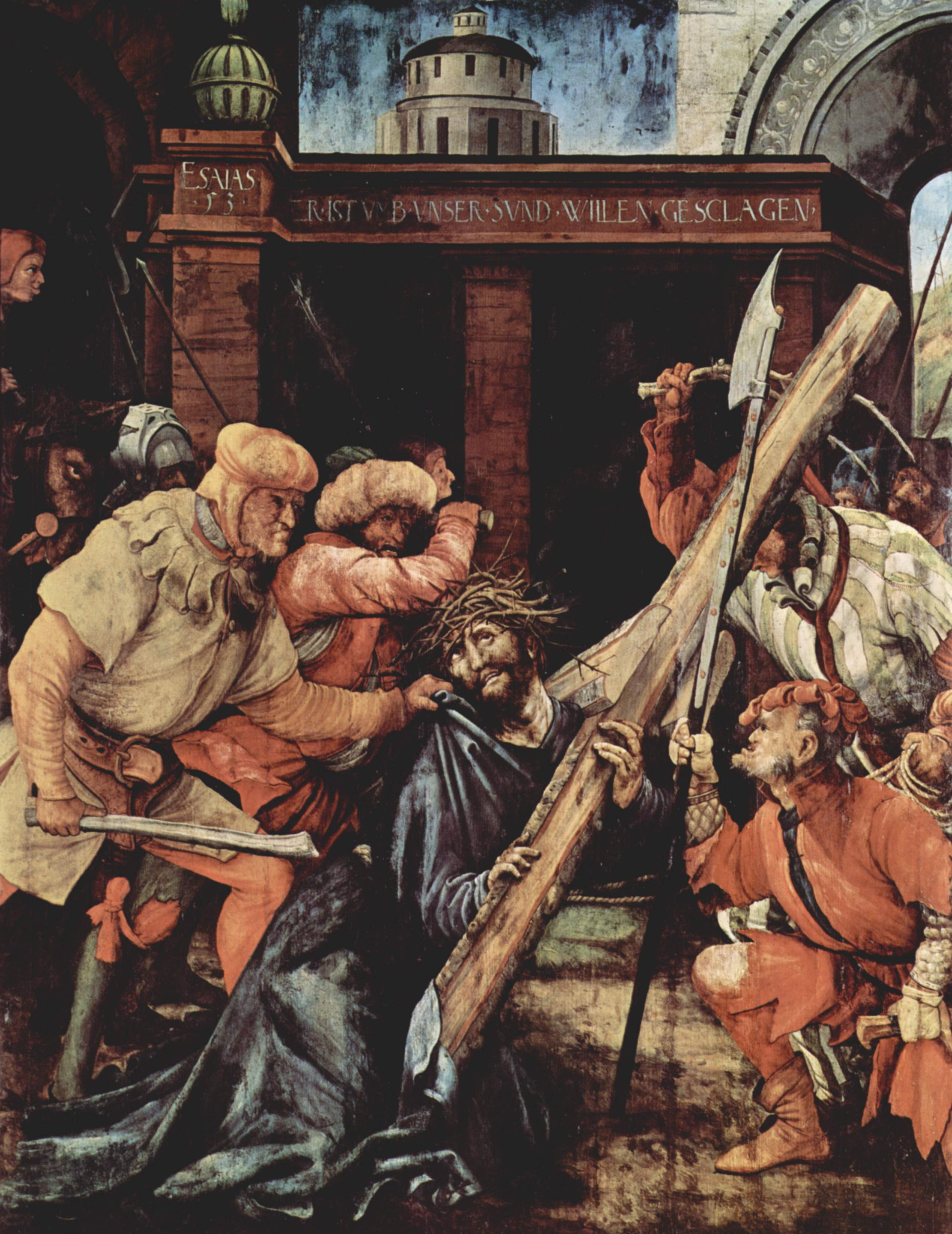

File:Mathis Gothart Grünewald 060.jpg

How radical a writer was Bernhard? Here is the publisher's description of his novel Gargoyles (a charming Christmas tale for the kids): "One morning a doctor and his son set out on daily rounds through the grim, mountainous Austrian countryside. They observe the colorful characters they encounter--from an innkeeper whose wife has been murdered to a crippled musical prodigy kept in a cage . . . " There's more. A "paranoid prince" and a "parade of human grotesques." No bestseller here. One imagines literary agents rushing to sign Bernhard to a mega-deal; motion pictures, a fawning review in Harper's, a Twittered version of the book for the attention-deficient crowd. Then again, perhaps not. On the surface, Bernhard is never a cheerful read, yet, as in The Castle, with its own version of the human nightmare, Bernhard's monsters are so clearly us that we laugh to feel reassured: yes, it really is all right to be vain, monomaniacal, greedy, and cruel. Bernhard's truths are often too much to bear, but they are truths nonetheless.

Reading Bernhard's Wittgenstein's Nephew or, my personal favorite, The Old Masters, one asks, 'what is comedy?'  Thanks to Shakespeare and Northrop Frye, we presume that comedies always veer toward weddings and renewals of life--as with the crocuses at the conclusion of Humbolt's Gift.  But also thanks to Shakespeare, we know there is more to comedy than transvestism, drunkenness, sexual double entendres, and nuptials. Shakespeare, after all, not only wrote "A Midsummer Night's Dream," but also "Measure for Measure," and "A Winter's Tale."  Aristotle taught us that tragedy purges pity and fear, but he also taught us that that comedy purges bitterness (ψόγος) and our  natural loathing of the absurd. One might argue that life is far more likely to provoke invective than a sense of fatedness--this is the central discovery of Kafka--a king knows tragedy, but we clerks feel absurdity in our bones.  The writer who thought "writing was praying," wrote these witty lines:

Last night I dreamt about you. What happened in detail I can hardly remember, all I know is that we kept merging into one another. I was you, you were me. Finally somehow you caught fire.”  

Somehow you caught fire. I have to laugh when I read this passage though there is nothing funny in it. Here is, I am certain, the meaning of Kafka's famous line about "the frozen sea within us."  Great literature wakes us up, and the more deeply we are asleep, the greater the tug needed to rouse us.

Bernhard travels a similar road, less fastidiously than Kafka:

"The atmosphere in Hoeller's house was still heavy, most of all with the circumstances of Roithamer's suicide, and seemed from the moment of my arrival favorable to my plan of working on Roithamer's papers there, specifically in Hoeller's garret, sifting and sorting Rooithamer's papers and even, as I suddenly decided, simultaneously writing my own account of my work on these papers, as I have here begun to do, aided by having been able to move straight into Hoeller's garret without any reservations on Hoeller's part, even though the house had other suitable accommodations, I deliberately moved into that four-by-five-meter garret Roithamer was always so fond of, which was so ideal, especially in his last years, for his purposes, where I could stay as long as I liked, it was all the same to hoeller, in this house built by the headstrong Hoeller in Defiance of every rule of reason and architecture right here in the Aurach gorge, in the garret which Hoeller had designed and built as if for Roithamer's purposes, where, Roithamer, after sixteen years in England with me, had spent the final years of his life almost continuously, and even prior to that he had found it convenient to spend at least his nights in the garret, especially while he was building the Cone for his sister in the Kobernausser forest, all the time the Cone was under construction he no long slept at home ....."  

This sentence continues, in the least compromising of all Bernhard's novels--Correction--and reprises all of the (three) numbingly and, eventually, hysterically repeated themes of the novel--the garret, the Cone, and the papers of Roithamer, another of the many stand-ins for Wittgenstein who often appears, thinly disguised, in Bernhard's novels.  How attractive the Wittgenstein's must have been to Bernhard--a family decimated by suicides!  One wonders what the austere logician of the Tractatus would have made of  Correction's baroque syntax and its relentless mockery of seriousness and taciturnity.  I've just quoted a passage from pages one and two; weeks later (it seems) we arrive on page one hundred twenty five and find this: "If I walk barefoot they won't hear me, I'd thought, and so as soon as I'd entered Hoeller's garret I walked around and back and forth a lot in my bare feet in order to practice this barefoot walking in Hoeller's garret..." One feels as if one is trotting up the down staircase, or trapped in a dream of jogging endlessly for a bus, not moving one inch. Or one is living one's life, as it is, and not moving one inch.

 "The limits of my language are the limits of my world," wrote Wittgenstein, and Bernhard appears to counter with the proposition "Even within the limits of language there is to be found an unlimited world."  This is what Bernhard shares with Kafka--the conviction that language need not take us anywhere--through neither narrative nor conclusion--to show the meaning of the world.  Why do we need beginnings, middles, and endings when, as in Kabala, every word is capable of pushing us into the abyss?



*See David Foster Wallace, "Some Remarks on Kafka's Funniness from Which Probably Not Enough Has Been Removed," in Consider the Lobster. Typical Wallace: "It's not that students don't 'get' Kafka's humor but that we've taught them to see humor as something you get--the same way we've taught them that a self is something you just have. No wonder they cannot appreciate the really central Kafka joke: that the horrific struggle to establish a human self results in a self whose humanity is inseperable from the horrific struggle."  It is much the same with Bernhard, with outcomes more likely to result in despair than resignation. 

Perhaps as a bit of publishing pro bono work, one finds Thomas Bernhard's books in so-so Vintage Paperback editions, with outdated prefaces (by, for example, George Steiner--two pages!).  But this is being rectified, as in the new edition of Gargoyles, which has no introduction whatsoever. 

Bernhard, the wittiest of misanthropes, whose account of his literary prizes (My Prizes: An Accounting)  is the last word in the genre of Self-Justifiying Public Ingratitude, isn't for the faint of heart.  But you never know: look at how popular David Lynch was for a few seconds.  The Bernhard lover hopes a serious press will take up the cause--and quickly--of reissuing TB in suitable editions so that one can disseminate mordancy at the appropriate holidays.  


George Ovitt (1/25)


Wednesday, May 21, 2014

Geoff Dyer is a Very Strange Person

Three by Dyer:

Out of Sheer Rage: Wrestling With D.H. Lawrence

The Ongoing Moment

Yoga for People Who Can't Be Bothered to Do It


I always laugh when I think of Eric Idle in Monty Python and the Holy Grail saying (of the Frenchman who is taunting King Arthur) "What a strange person!"  Though he's extremely smart and one of the most engaging writers around, when I read Dyer I feel that either he is a very strange person (and wouldn't be offended to hear you say it and would be great fun to get drunk with) or he has perfected a literary persona who could be a member of the cast of Fawlty Towers.  In my favorite of his books, Out of Sheer Rage, a memoir/biography/travelogue circling around the subject of how Dyer manages to avoid writing a book about D.H. Lawrence, Dyer channels a strange brew of Thomas Bernhard and Rodney Dangerfield--an intellectual malcontent who travels compulsively, is misanthropic and self-absorbed, hedonistic (Dyer often smokes weed and, despite his minutely categorized physical deformities, is never without a beautiful woman with whom to have lots of sex), untrustworthy, opinionated, and, come to think of it, not all that different from David Herbert himself.  It didn't occur to me until late in the book that Dyer was channeling Lawrence--a writer so self-absorbed, priapistic, and clueless about other people as to invite exactly the sort of parody served up by the witty Dyer. But even more than Lawrence--a writer I have never been able to warm up to, and whose books I read only for the sake of some grad school course--the presiding genius of Out of Sheer Rage is Bernhard, as here, in Dyer's send up of academic literary criticism:

"I burned it [the book of lit-crit essays about Lawrence] in self-defense.  It was the book or me because writing like that kills everything it touches.  That is the hallmark of academic criticism: it kills everything it touches.  Walk around a university campus and there is an almost palpable smell of death about the place because hundreds of academics are busy killing everything they touch."

That's Bernhard: no complaint is worth making that can't be made three times.  And no grievance is ever anything less than fatal--compare Dyer here to Bernhard's Concrete or Gargoyles for the origin of a style that recognizes life as neither comic nor tragic but farcical. Dyer's riffs on where to live, on why he hates eating fish, on bathing at a nude beach in Mexico, on not speaking foreign languages, on his long-suffering girlfriend Laura, are funny in the sense of not servicing that annoying ironic urge of educated people to laugh at everything, but in the sense of Dyer's being willing to focus on how foolish we are when we can't control our contrary desires.  

Dyer is likely to make you laugh out loud.  As when he confesses he honestly can't even read Lawrence except for one or two of the most obscure of his travel books; Dyer would rather read Rilke than Lawrence any day, and much of the time the observations about Lawrence and on literature that Dyer makes draw on a sensibility that is Germanic and Rilkian rather than English and Lawrencian.  That is, a sensibility that is Apollonian rather than Dionysian, or formal rather than felt.  Dyer's ambivalence toward DHL extends to England itself: away from home on some distant "research trip" in New or Old Mexico, Dyer waxes nostalgic about England but can't think of anything he misses but the telly.  One of the best bits comes when Dyer leaves Paris and agonizes over where to live--he hates children so he's footloose and could live anywhere--he tries Rome but ends up, of all places, in Dullford, Oxford, land of academics and bores. But of course Lawrence loathed England, left early and didn't return, but remained an Englishman all his (brief) life.  Dyer's play with these facts of Lawerence's bizarre, restless existence (how did DHL ever get any work done?) are really quite brilliant: I'm rather surprised Dyer didn't perish of TB by book's end.  But then, the ending of Out of Sheer Rage is extraordinary, not to be given away here.

The most obvious influence on Dyer's work isn't Lawrence or Rilke or even Bernhard but John Berger (right), the remarkable novelist, art critic, travel writer,  and cultural critic.  Dyer edited Berger's Selected Essays and contributed an admiring essay to the volume (which I have been enjoying, an essay a day, for a month now).  Other evidence of Berger's influence on Dyer is the latter's The Ongoing Moment, a smart and incisive book-length essay on the photography of Stieglitz, Paul Strand, Walker Evans, André Kertész, Edward Weston, Dorothea Lange, Diane Arbus, and William Eggleston.  Dyer looks at clusters of related photographs, including portraits of the photographers by their peers. His insights into the art of the photograph are impressive for an amateur--the book contains so many interesting ideas that I couldn't make up my mind which quotation to include here.  How about this:

"In Stieglitz, the will to power was both highly and insufficiently developed.  Highly developed in that he had to overcome others; inadequately developed because he was powerless to achieve the ultimate Nietzschean project of self-overcoming."

As someone who knows very little about the history of photography, I profited from Dyer's close readings of particular artists and their styles--for example how Dorothea Lang approached the composition of thematic scenes--her sequence of blind beggars, for instance.  Dyer also sent me back to books on Kertész and Walker Evans, photographers whose images of New York evoke a beautiful city that is now gone.


As for Yoga: well, the reviewers claim to have loved this collection of essays about Dyer's vertigo-inducing travels; I've renounced travel myself, so a vicarious adventure in Thailand isn't unwelcome.  But I didn't care for this book.  I made it through three or four of the "essays" (actually, loose bits of memoir) but quickly tired of the book.  My Dyer problem began when he tried to outdo Bruce Chatwin: What's the weirdest thing you've ever done in a foreign country?  How gross were the poor people?  How vile were the accommodations?  I do have sympathy for the traveler who hates everything about going places; when I used to travel I would find everything about my journey insufferable aside from the memories of the journey once I was safely at home.  While I enjoy Dyer as a travel writer, that isn't his strength--he's best when he's at home (wherever that might be) just being himself, thinking, paying attention, looking at pictures or people, complaining.  Anyway, my all-time favorite gonzo travel writer (who I want to plug here) is Redmond O'Hanlon (see if you can lay hands on In Trouble Again) who is, if anything, crazier than Dyer.  

If you haven't read Dyer, pick up one of his books. There's plenty of them.  I'm just starting on his fiction now and am looking forward to his book on jazz, But Beautiful.  Here's Dyer's workroom.  The red walls seem right: manic color for a manic writer.


 George Ovitt (May 21, 2014)


Sunday, May 26, 2013

And the living isn't easy.....

Summertime by J.M. Coetzee


I've been reading Coetzee all week, one of the writers I most admire and whose books I enjoy revisiting year after year.  In his early novels, up to The Master of Petersburg, Coetzee wrote about South Africa--recording his sense of nostalgia mingled with loathing for the mythic Afrikaner past and his hatred for apartheid (Life & Times of Michael K and Waiting for the Barbarians).  Master of Petersburg was a transitional book, a brilliantly inventive novel about Dostoevsky's private life, published in 1994, the year Coetzee's son died at age 23.   The novels that followed, beginning with Disgrace (1999), which many readers consider Coetzee's finest and most disturbing book, examine in greater detail dilemmas of personal authenticity and identify--still against the backdrop of South Africa's history--and deflect political questions into the realm of  (mostly failed) individual struggles to live a meaningful life; in other words, they take up the themes that preoccupied Dostoevsky himself. Coetzee is the most cerebral of writers, and it would be foolish to attempt an easy categorization of his work, but one can discover in a sequential study of his novels a gradual movement inward, an increasing focus on autobiography and "problems of the self," beginning with Youth, and continuing through Elizabeth Costello, Slow Man, Diary of a Bad Year, and culminating in Summertime.


Coetzee's autobiographical writings remind me of Bernhard's Gathering Evidence and, to a lesser extent, Philip Roth's Zuckerman novels--intense, unsparing self-portraits of the artist; of the three, Coetzee is the least inclined to give himself the benefit of the doubt.  His portrayals of "John" in Summertime or of "Señor C" in Diary of a Bad Year can make the Coetzee admirer cringe before the author's Puritanical lack of sentiment:

"In Coetzee's eyes, we human beings will never abandon politics because politics is too convenient and too attractive as a theatre in which to give play to our baser emotions. Baser emotions meaning hatred and rancor and spite and jealousy and bloodlust and so forth.  In other words politics is a symptom of our fallen state and expresses that fallen state."

Summertime purports to be the interview notes of someone named Vincent, an English biographer who is writing about Coetzee's "lost years," his thirties, the years in South Africa when "John" was living an odd existence in a run-down house with his father, working part-time as a tutor, and preparing to compose Dusklands, his first novel (which was in fact written while Coetzee was teaching at SUNY Buffalo in 1971).  Vincent speaks to a woman with whom John had a brief, unsatisfying affair; with a cousin; with a Brazilian woman who was the unmoved object of John's infatuation; a male acquaintance (John had no friends); and a Frenchwoman, a colleague at the University of Cape Town, whose liaison with John was also unfulfilling and quickly terminated.  From these fragmentary interviews a portrait of the (deceased) John Coetzee emerges that is far from flattering: he was, we learn, socially awkward, lonely, "boney," a poor lover, incompetent, unmanly, shy, and, while perhaps talented, not a writer his lovers, relations, or friends considered worth their time.  Throughout these portraits the tone is mordant, deadpan,and without apparent irony.  It is as if Coetzee were constructing his post-mortem reputation without resort to the illusions the rest of us use to insulate ourselves from the truth--we are, all of us, foolish in the eyes of others, deluded as to our own significance.  Coetzee shares with Bernhard an unromantic view of the human tragicomedy--nothing is funny about our follies and cruelties and self-delusions--the best thing we can do is face the facts and bend to our fate.  While his early books are preoccupied with political will (if not idealism), Coetzee's work after 1999 is suffused with a sense of fate; he is, as one character in Summertime remarks, a Calvinist through and through.


Then again, no writer I can think of better disguises his commitments and beliefs.  We know Coetzee is a vegetarian (Elizabeth Costello), a bicycle enthusiast (Slow Man), and disgusted by the treatment he received in his native country (Disgrace and its aftermath).  But as is the case with Bernhard, the ruthless honesty of a great writer is no guarantee of his sincerity.  The conjuring of multiple fictional personae in Coetzee's work might delude us into thinking--like Mr. Vincent, the erstwhile and frustrated biographer--that we "know" the writer, but in the end, like Vincent, all we have are fragments of a complex and often contradictory imaginative life. 

"...[John's French mistress speaking] John did not have a strong presence. I don't mean to sound flippant.  I know he had many admirers; he was not awarded the Nobel Prize for nothing; and of course you would not be here today, doing these researches, if you did not think he was important as a writer.  But--to be serious for a moment--in all the time I was with him I never had the feeling I was with an exception person....he had no special sensitivity that I could detect, no original insight into the human condition. He was just a man, a man of his time, talented, maybe even gifted, but, frankly, not a giant." 

Or, this: there is no "original insight into the human condition," only its precise recording in flawless  prose.  Nothing more; but what more is needed?

George Ovitt (5/26/13)


Monday, March 24, 2014

The Post-Modern Family

Tirza, by Arnon Grunberg


How many books have actually caused you to laugh out loud?  I remember laughing to the point of crying at the Major Major sections of Catch-22.  Vonnegut can still make me laugh in one paragraph and nearly weep in the next; Dorothy Parker's little stories ("The Cradle of Civilization") are quite funny, and while I don't think this is entirely normal, whenever I need to cheer up I reach for Thomas Bernhard--the only writer I know of who can make suicide seem witty--or I'll reread the sections of Pale King that reliably do the trick (e.g. David Cusk's sweating episodes).  On the other hand I don't find the New Yorker's "Shouts and Murmurs" funny--ever--nor do I even chuckle at David Sedaris, Calvin Trillin, or the late Nora Ephron. But I at least smile when I try to read Heidegger or Hegel--what else can one do?--and so I admit that my sense of humor is quirky and probably says more about the oddities of my character than anything else.  I've been reading The Island of Second Sight by Albert Vigoleis Thelen (which is why I haven't been writing here), and it occurred to me at about page 150 that it was the heavy-handed, almost self-parodying irony that, more than anything else, was keeping me from enjoying the book.  But irony, deftly deployed, can be funny, as it is, for example, in A.M. Homes's delightfully weird novels.  Bernhard's running joke is the same one that made MAD magazine so smart back in its Al Feldstein/William Gaines years--namely the conceit that everything is absurd if examined properly, that is, honestly.  Irony, of course, is the recognition that the "meaning" (scare quotes de rigueur) of experience is slippery at best, that there are no "final" or definitive correspondences to anything in our relationships and our inner lives; every human exchange has an ulterior motive or is fraught with ambiguity.  There's nothing in this formulation that is inherently funny, so that Thelen's pounding away at the quirkiness of his alter ego's experiences isn't funny, while Bernhard's repetitive, Beckettian, over-the-top formulas (the Cone!) do the necessary work of humor, which is to relieve us of the burden of seriousness--after all, comedy releases us from fate, assuring us that either we are in control of our lives or no one is. I remember reading once that there could be no Christian tragedy; maybe so, but there can't be any Christian comedy either, except in Dante's sense of comedy as transcendence.  There is no point in lamenting a world that makes no sense, so one might as well laugh at it.  (See Watt, page 37)  The forbidden is funny, as is the gross, and even the unspeakable can be funny in context--comic relief--but then all of these things are stupid and embarrassing if not done with intelligence.  Tragedy is natural in storytelling--the narrative arc is built in--but the comedic plot presents an altogether difference sort of problem.  I respect a writer that does tragedy well; I marvel at one who can do comedy.


"One more thing about paranoia and irony: paranoia without irony is unbearable. And the combination of paranoia and irony might still be the best answer to the horror of our times." 

Aaron Grunberg, the Dutch novelist who lives in New York, and who is, I suspect, right at this moment working in his kitchen in Queens (he writes in the morning, in his kitchen, listening to music, and, apparently, hooked up to an EKG as part of a study of the creative process--I like picturing this), also writes a blog that I have been enjoying--he has opinions on everything, and they're often good ones: as in the quotation above: paranoia without irony is unbearable.   You can tell Grunberg has been in the U.S. a while--paranoia has replaced optimism everywhere: we're being watched, and what we're doing, though hardly worth a second thought, is probably illegal.  His novel Tirza, which I enjoyed, is set in an upscale enclave of Amsterdam, though its disturbed and disturbing central character Jorgen Hofmeester could just as easily live in Gotham City, though not in Ed Koch's favorite borough--maybe on the Upper East Side--where the horrifying and hysterical (in both senses of the word) unraveling of his family would seem no more absurd that anything else currently transpiring (how's this: "A Generation Redefines Mourning: Millennials have begun projecting their own digitalized sensibilities onto rituals and discussions surrounding death," NYT, 3/23/14; my emphasis). 


 So: Hofmeester's wife has left him, but, spectacularly, returns on the eve of the big party he is throwing for his youngest daughter, Tirza.  Mrs. H has been off with a lover or ten, living on a houseboat; she is, it transpires, a slut, while hyper-bourgeoise Jorgen has fantasies of "dirty" salesgirls. Hofmeester's reunion with his estranged wife is one of the funniest and most cringe-inducing enactments of marital hatred I have ever read.  Ibi, Hofmeester's oldest daughter, loathes her parents and has run off to France; Tirza has what can only be described as unnatural affection for her father--who reciprocates by making his youngest daughter the center of his paranoid and ironic universe. Hofmeester himself has been let go from his job as an editor and passes his days at the airport, acting the role of a person who awaits the arrival of a loved one; he also cooks and cultivates the image, but not the substance, of a concerned father.  Tirza has a boyfriend who looks like Mohammed Atta, at least to her father, and is ingenuous to the point of idiocy.  The party, which occupies much of the book, is hellish and yet utterly banal--Grunberg excels at depicting the calamity that is everyday life.

Yes, we've come a long way from "Father Knows Best," all the way from bland patriarchy through emasculating feminism to unmitigated domestic horror.  But the horror stories no longer require ghosts or vampires or zombies--now everyone is a monster, and the wittiness of a book like Tirza derives from the absurd notion that there ever could have been such a thing as a happy family.  I won't mention the Sopranos here, or Walter White, but what Grundberg does with the nuclear family evokes the sort of rueful smiles of recognition one often had in watching Tony at table with Carmela and Meadow and little Anthony.  The post-modern family: no longer is the home a refuge from an unkind world but rather a perfect replica of that world.  Cruelty has become the face of love, and aside from the banality of pop fiction and network TV, everyone gets it--from Amsterdam to New York--the family is where we sharpen our claws, nothing but a dress rehearsal for the flaying we are expected to dish out in the "real" world. Ironically the roles have been reversed: now one goes to work to find a modicum of peace and quiet, bracing oneself for the return home, to the horrors of one's family.


   "Ibi was at a cafe with friends, the wife was painting in her studio and receiving her almost exclusively male models. Jorgen Hofmeester sat in the living room and underlined one paragraph after the other in the informative book about his youngest daughter's disorder, and in her bedroom beside the cello Tirza was busy giftedly starving herself to death.
   That was how the Hofmeester family lived at the start of the new millennium."


Tirza is published by Open Letter, University of Rochester, and translated by Sam Garrett.

George Ovitt, 3/24/14


Saturday, May 20, 2017

Variations On What We Know


The Voice Imitator: 104 Stories by Thomas Bernhard


[one love affair]
[thirteen instances of lunacy]
[twenty surprises]
[four disappearances]
[twenty-six murders]
[two instances of libel]
[six painful deaths]
[three character attacks]
[five early deaths]
[one memory lapse]
[four cover-ups]
[eight suicides]

If you have never read the fiction of Thomas Bernhard, The Voice Imitator may be the perfect place for you to start. Comprised of 104 roughly paragraph-length stories that resonate with the dark profundity of parables, the collection captures—writ small—the very eye and obsessions of this grave and exacting writer (see George Ovitt’s earlier post: Climbing Mount Mordant). Best known for his novels, Correction and Extinction, each an ardent defense of the life of the mind, each a dazzling screed against the perennial scourges of bigotry, dogmatism, hypocrisy, and greed, as Bernard found them flourishing in his native Austria, a country out of which, in his fiction and plays, he fashioned a veritable gospel of loathing. In these novels (in which he is all but indistinguishable from his narrators) he is no Tartuffe, but raves like a prophet of old. 


And what he says will shake you. Of photography—that sacred cow of our age—the narrator of his ultimate novel, Extinction, declares brilliantly, outrageously:

Photography is a vulgar addiction that is gradually taking hold of the whole of humanity, which is not only enamored of such distortion and perversion but completely sold on them, and will in due course, given the proliferation of photography, take the distorted and perverted world of the photograph to be the only real one. Practitioners of photography are guilty of one of the worst crimes it is possible to commit—of turning nature into a grotesque. The people in their photographs are nothing but pathetic dolls, disfigured beyond recognition, staring in alarm into the pitiless lens, brainless and repellent. Photography is a base passion that has taken hold of every continent and every section of the population, a sickness that afflicts the whole of humanity and is no longer curable. The inventor of the photographic art was the inventor of the most inhumane of all arts. To him we owe the ultimate distortion of nature and the human beings who form part of it, the reduction of human beings to perverse caricatures—his and theirs. I have yet to see a photograph that shows a normal person, a true and genuine person, just as I have yet to see one that gives a true and genuine representation of nature. Photography is the greatest disaster of the twentieth century.*

His novels are like a purgative, like a ritual cleansing of the intellect and soul. Dark, relentless, seemingly unforgiving as reflections on the human race, his vision is ultimately anything but cynical, anything but unctuous or pedantic, shot through as it is with a mordant, bitter-black wit that not only saves the reader from drowning but sets him firmly on his feet again, then hands him a flower to sniff! It is almost a reflex for me now that, whenever I’m feeling depressed, whenever I feel I’ve lost my way in the world again, I read a few pages of Bernhard and grin. 

Reading The Voice Imitator is not nearly as demanding as reading his novels, yet still bears the unmistakable stamp of his intelligence and eye. Wry, quirky, provocatively understated, the simple stories set one’s eyes askew. Here—a favorite of mine—is the first from the collection:

Near Oslo we met a man of about sixty who told us more about the old people’s home than we already knew from reading Hamsun’s accounts of the last year of his life, because he had been working in the home at precisely the time  during which the greatest of Norwegian writers was living there. The man’s taciturnity had attracted our attention in the inn near Oslo—usually so noisy on a Friday evening—where we were staying for several nights. After we had sat down at his table and introduced ourselves, we learned that the man had originally been a philosophy student and had, among other things, spent four years studying at Göttingen.  We had taken him for  Norwegian ship’s captain and had come to his table to hear some more about seafaring, not about philosophy, from which, indeed, we had fled north from Central Europe. But the man didn’t bother us with philosophy and said he had actually given up philosophy overnight and put himself at the disposal of geriatrics at the age of twenty-seven. He said he did not regret his decision. He told us his first task had been to help an old man get out of bed, make the bed for him, and then put him back into it. The old man was Hamsun. He had looked after Hamsun every day for several months, had taken him out into the garden that lay behind the old people’s home, and had gone to the village for him to buy the pencils that Hamsun used to write his last book. He was, he said, the first person to see Hamsun dead. In the nature of things, he said, he was not yet certain who Hamsun was when he pulled the sheet up over his face.  

Here, in much the same tone, is another, this one called ‘Charity’:

An old lady who lived near us had gone too far in her charity, She had, as she thought, taken in a poor Turk, who at the outset was grateful that he no longer had to live in a hovel scheduled to be torn down but was now—through the charity of the old lady—allowed to live in her town house surrounded by a large garden. He had made himself useful to the old lady as a gardener and, as time went by, was not only completely re-outfitted with clothes by her but was actually pampered by her. One day the Turk appeared at the police station and reported that he had murdered the old lady who had, out of charity, taken him into her house. Strangled, as the officers of the court determined on the visit they immediately made to the scene of the crime. When the Turk was asked by the officers of the court why he had murdered the old lady by strangling her, he replied, out of charity.

Now ‘The Milkmaid’:

Last week we witnessed the spectacle of five cows running, one after the other, into the express train in which we had to return to Vienna and of seeing them all cut to pieces. After the track had been cleared by the train crew and even by the driver, who came along with a pick-ax, the train proceeded after a delay of about forty minutes. Looking out of the window I caught sight of the milkmaid as she ran screaming towards a farmyard in the dusk.


Finally, to conclude this post, a simple, haunting story called ‘Giant’:

In the cemetery in Elixhausen, some workmen who had been hired to build a crypt for the late owner of a cheese factory excavated, at a depth of about two feet, the skeleton of a man who must have been nine feet tall and who had apparently been buried 150 years ago. As far back as anyone can recall, only very short people are thought to have lived in Elixhausen.


* My apology for having quoted a part of this passage in an earlier post. I simply couldn’t resist.

Peter Adam Nash

Wednesday, September 21, 2016

Cerote


Revulsion: Thomas Bernhard in San Salvador
                                                          by Horacio Castellanos Moya

For many readers (and writers) like me, the novelist Thomas Bernhard stands, now some twenty years after his death, as a literary prophet, a destroyer of idols, a seer-priest of the secular-humanist world. Relentless in his criticism of his native Austria, of the hypocrisy, dogmatism, jingoism, racism, and philistinism he found in such abundance there, he revered the loner, the scholar (what he called Geistesmenschen 0r ‘spirit-people’), the eccentrically, brilliantly, mad. 

Enter Edgardo Vega, expatriate professor, returning from exile in Canada to war-torn El Salvador for his mother’s funeral. When the novel opens we find him sitting with an old friend of his, following his mother’s wake, in a bar called La Lumbre, where he has been biding his time before returning for good to Montreal. The conversation, a single long paragraph, is charged with urgency, bitterness, and fury. “…I have to chat with you before I leave,” explains Vega to his friend, “I have to tell you what I think about all this nastiness, there’s no one else I can relate my impressions to, the horrible thoughts I’ve had here…” What follows is a dazzling tirade against his native land and its cultural self-destruction as the result of its recent civil war, a virtual apocalypse of greed and violence that laid waste to nearly everything he held dear. Writes Castellanos Moya, “With the relish of the resentful getting even, I wanted to demolish the culture and politics of San Salvador, same as Bernhard had done with Salzburg, with the pleasure of diatribe and mimicry.”


Surely he had plenty against which to rail, against which to vent his ardent spleen. The twelve year Salvadoran Civil War (1979-1992), a struggle for power between the military-led government of General Carlos Humberto Romero and the FMLN (Farabundo Marti Liberation Front), was one of the most violent chapters in the history of Central America, claiming the lives of more than 75,ooo people. Wrote Reinaldo Figueredo, in his summary of the conflict for the U.N. Truth Commission, “In examining the staggering breadth of the violence that occurred in El Salvador, the Commission was moved by the senselessness of the killings, the brutality with which they were committed, the terror that they created in the people, in other words the madness, or locura, of war.”

Robert Walser once said, “You can’t confront your own country with impunity.” In the case of Castellanos Moya, he was right about that, for shortly after the novel’s publication his mother, still living in San Salvador, received a death threat from an anonymous caller. The author himself was warned never to return, as Salvadorans at large were incensed by the novel, by his unforgiving portrait of them and their country. Even friends and family were enraged by this brief, acerbic tale in which he spared nothing and no one, excoriating them for their papusas and their politics, and lambasting their language itself with his sharp and fulsome ire: “…not in vain is cerote the most repeated word in their language, they don’t have any other words in their mouths; their vocabulary is limited to this word cerote and its derivatives: ceretísimo, cerotear, cerotada.” Cerote—as you might have guessed by now—means ‘shit’.
 
In what was perhaps a gesture of consolation to his disgruntled compatriots, Castellanos Moya explained “…that some countries would require many more pages to complete their Revulsion…”! I guess even a back-handed compliment is better than none at all. 

 
Peter Adam Nash 

Friday, December 19, 2014

Ten Favorite Books of 2014


Our mountains look roughly like this at the moment--a couple of brief dustings of snow this past week, altostratus and stratocumulus clouds against an otherwise clear sky, cold, but not too. No, please don't move here--believe me, you wouldn't like it. But even from my first-floor study window, through the now-bare elms and cottonwoods, I can see the gray-blue-oranage beginning to mass on the summit--it's quite lovely, though an acquired taste.

Today was also the day that the Times published its "Ten Best Books of 2014" list, an event I look forward to so as to receive some guidance in my last minute holiday shopping.  If you don't bother with the Times, you may not know that the paper has three full-time book critics--Janet Maslin (the light stuff), Dwight Garner (likely to review a book that, if you read this blog, you might enjoy reading yourself), and  Michiko Kakutani (in charge of championing Establishment books, thereby insuring that the Times never strays from the acceptable literary mainstream). Gore Vidal called what the Times does "book chat." If you want literary criticism, read James Wood. The Times preserves, at all costs, the middle-brow in literature (the upper middle brow), so what you won't find in their "best" list (why not just call it "ten books worth reading" or "ten of the better books"?) would be anything from Eastern Europe, plotless, genuinely political, or genuinely difficult. Which is fine, but in some ways also a shame since a review in the newspaper of record bestows credibility and sales on lesser-known publishers (not to mention their writers) and would go a long way toward keeping diversity alive in publishing. But, for the most part, the three reviewers stick to the big New York houses and their authors.They perform a service, but given about 300 reviews a year, not as much of a service as one might hope.

I admit I haven't read too many of the Times books this year. Four, to be exact. Karl Ove Knausgaard's My Struggle, Volume III; Foreign Gods (see below); Elizabeth Kolbert's The Sixth Extinction, Ben Lerner's 10:04, and about 50 pages of  Redeployment by Phil Klay. No way was I going to read Robert M. Gates Duty: Memoirs of the Secretary at War since you pretty much know it will have all the credibility of a Kissinger memoir. Garner's list was the best one since he included Hermione Lee's new biography of Penelope Fitzgerald and Teju Cole's Every Day is For the Thief (which I plan to read soon).  Ms. Maslin has included one book about hackers, one book about Wall Street, and one book about a feisty furniture manufacturer--we're not talking belles lettres here.  Kakutani, in keeping with her portfolio, got stuck with Gates, or maybe chose it, and mostly stuck to books put out by Knopf and Random House, two great publishers who have become incredibly conservative in their lists.  Farrar is now the best source of good books outside of the independent publishers, and they haven't compromised on the quality of their product either; I just purchased Leopardi's 2500-page Zibaldone from them and it is a gorgeous book. Don't get me wrong, I'm sure the Times' list is full of fine books, but why is there no novel by the Nobel Prize winner? Only one book of poetry? No history, philosophy, or political writing? Kolbert's book is brave, well-written, and timely--but hers is the only one on the list that tackles any questions of real substance.


Who am I to talk? Hell, I don't even live in Brooklyn! Look at all I've left out! And my list isn't entirely of books published this year. This list-making fetish is becoming idiotic. Everybody is making lists--The 100 Top Sushi Bars in Des Moines!--what's the point? On the other hand, it was a pleasure to have spent two hours thinking back over the many fine books I was able to read this year. Pulling them off the shelf, remembering the joy I had reading them, piling them up and trying to decide which ones had meant the most to me. Choosing wasn't easy, and by the time I had decided on my ten the sun was setting and the mountains had disappeared.

In no particular order:

1--Thomas Bernhard: Extinction: His final novel and his most representative. My favorite Bernhard is whichever one I am reading at the moment (Frost).  A plot summary? Are you kidding? Don't read page 47 of the Vintage edition with coffee in your mouth, as I did, ruining a nice book and nearly choking with merriment.  Bernhard-induced laughter is like no other. The only writer who never fails to cheer me up.

2--Giacomo Leopardi: Canti, beautifully translated by Jonathan Galassi (Farrar Straus Giroux): Italy's second greatest poet and the finest of the Romantic poets, period. (Book critics need to be sure of themselves).

3--Reiner Stach: Kafka: The Years of Insight: I read an above average number of literary biographies, and this one, the second of a three-volume life of the consummate modernist, is as engaging, well-written, and as worthy of its subject as any I've ever read. It was translated by Shelly Frisch who is extraordinary and deserves to have her picture here--it was published by Princeton, the fine press that also did the Joseph Frank biography of Dostoevsky, which many readers consider the finest literary biography ever written. I also read that one (abridged) this past year, but preferred Stach's Kafka by the slimmest of margins.


4--Charles Wright: Bye-and-Bye: Selected Later Poems (Farrar Straus Giroux): poignant, lyrical, deeply felt, rich in expression, moving...our new poet laureate, the one job in government through which one might truly make a positive difference to people. I've been carrying this book everywhere for four months.

5--Geoff Dyer: Out of Sheer Rage (Vintage): Dyer's take on D.H. Lawrence. Only Dyer could make the maudlin, self-regarding, utterly tedious Lawrence interesting--but Dyer can make anything interesting. Actually OOSR is more of a book about Dyer, which is just as well. Not new, but who cares? Really good.

6--Drago Jancar: Joyce's Pupil (Brandon): Twelve stories of love, death, and chaos by the Slovenian master. My favorite stories of the year.

7--Arnon Grunberg: Tirza (Open Letter): Strange doings in Amsterdam and Africa--utterly compelling as a study of the degeneration of an ordinary man who finds himself--as we all do--in an insane world.

8--Ben Lerner: 10:04 (Faber and Faber): I just finished Lerner's new novel last week. He thinks of himself primarily as a poet, but I have tried (twice) to read Angle of Yaw and gotten nowhere. But as a novelist Lerner has real genius. This is a book that is difficult to categorize and therefore even better. Definitely give this one a look.

9--Faces of Love: Hafez and the Poets of Shiraz (Penguin): translated by Dick Davis. Persian love poems with a remarkably informative introduction by the translator. "However old, incapable/And heart sick I may be, /The moment I recall your face/My youth's restored to me..." Not a new book, but for me an untried poet and an utterly fresh reading experience.

10--Penelope Fitzgerald: The Blue Flower (Mariner): I've just reread Fitzgerald's novel of the German poet Novalis. Reading about the Lee biography of the eccentric, productive, unclassifiable Fitzgerald made me want to go back to this book after many years. A great odd-ball novel. There are parts of this book that are literally unlike anything that's every been written by anyone. Do read it!

May I have two runners up? Thomas Pikkety's Capital which would be on this list if I had been able to read the entire book but I pooped out in the middle. It's extraordinary, but mostly over my head. Antonio Machado's poetry in two different translations. I loved The Landscare of Castille as translated by Mary G. Berg and Dennis Maloney (White Pine Press), and I wanted to note how much I am enjoying both Foreign Gods by Okey Ndibe and Monica Maristain's Bolano: A Biography in Conversations (Melville House). I hope to write more about these books when I finish them.

Meanwhile, happy reading at the end of the year, and I wish you great reading in the New Year.


George Ovitt (12/19/14)


Wednesday, June 26, 2013

Death In (Not Venice But) Rome


death in rome by Wolfgang Koeppen

Death in Rome is the most devastating novel about the Germans that I have ever read,” writes translator Michael Hofmann in his introduction, a case he makes compelling even before one considers the tale itself.

In the aftermath of World War II, German writers were forced to pick up the pieces of their world, while somehow coming to terms with the murder and destruction that they (and their parents and grandparents) had wrought. As the losers and “villains” of the war, villains of a stripe not seen before, their task was markedly different than that of, say, the French intellectuals and writers in Paris, whom I touched upon in my last post on Simone de Beauvoir. Some German writers, writers such as Arno Schmidt and Günter Eich, found it too much or not useful to confront the past directly, choosing instead to explore German racism, violence, and guilt through means more symbolic and abstract.

Then too there was the need, the desire, to forget, to start afresh. After a brief (some would say unconscionably brief) period of moral scrutiny the country was ready to move on, an instinct, a compulsion, that soon gave rise to the post-war “German Miracle”  or Wirtschaftswunder, a surge in economic growth and cultural regeneration, a “phoenix act,” for which many German writers (not to mention politicians) were happy to write the script. As Hofmann remarks, the status quo ante 1933 was not restored after the war. “Instead, the story was one of discontinuity. It was as though the literature had been bombed as the cities had been.” Indeed many of the new generation of writers, like those of the controversial Gruppe 47, chose to make a clean break from the country’s literary (if not historical) past, as represented by Thomas Mann, to turn their backs on the war, the results and verdict of which seemed clear enough. As Aaron Dennis Horton writes, “This group of writers believed their work represented a new beginning for German literature, just as 1945, the so-called ‘zero hour,’ allegedly signified the start of a new era in German history, separate from the Nazi past.” Writing what came to be known as Trümmerliteratur or "rubble literature," they were determined to start with a clean slate, their focus the here and now, the future rising fast before their eyes. This is not to say that these writers denied or attempted to ignore German culpability in the war, only that they were often torn in their aims. Most notable among them were Alfred Andersch, Heinrich Böll, Siegfried Lenz, and Günter Grass, all of whom fought under Hitler but were ardently anti-Nazi. With two Nobel laureates among them, they are undoubtedly the best-known German writers in the world. 

Then there were the lonely, lesser-known writers like Wolfgang Koeppen whose relentless condemnation of the new Germany, with its collective amnesia and devotion to Mammon, now rings like a bell. Shaped by the works of Proust, Kafka, Faulkner, Woolf, and Mann, he came of age as a writer in the 1930s then fled. “He went abroad. He wasn’t a Nazi.  He returned.” Unfortunately the cultural landscape had changed, so that his novels of the 1950s, “works of memory and continuance and criticism,” were met with widespread reproach and contempt, savaged by “the modish and dirigible German public” for their often brutal candor at a time when Germans were just beginning to like themselves again.


Of those novels, Death in Rome is an especially trenchant look at the sickness and psychology of post-war Germans. Focusing on the reunion of a large German family in Rome in the early 1950s, a story of fathers and sons, husbands and wives, cousins and cousins, the real Geist of the story is the megalomaniacal, “unreconstructed and unkillable SS man” Gottlieb Judejahn, who—on the run and uncover of false identity papers—storms about the ruins of Rome, addled by dreams of Valhalla and the certain redemption of Grossdeutschland.   

The title’s echoing of Mann’s Death in Venice is particularly apt. Written (as was Death in Venice) with a combination of what Mann called “myth plus psychology,” Death In Rome is densely layered with allusions to Scandinavian mythology (so dear to the Nazis) and to the near-mythical German history in Rome, from Alaric the Goth to the Holy Roman Emperor Charlemagne to ‘Der Führer,’ Adolf Hitler. That Mann’s novella—shot through with contagion and death—was also a study in moral responsibility must surely have appealed to Koeppen as well. 

Of the author, finally, Hofmann writes, “There is something implacable, almost vindictive—like one of his Furies—about his pursuit of the Germans post-war, post-Holocaust, post-division, turning away from their crimes towards rehabilitation and their EC, once again exporting their goods and their culture and themselves. He shows them to us. All of them.” Like his Austrian counterpart, Thomas Bernhard, Koeppen was never afraid to dirty his own nest.*


Wolfgang Arthur Reinhold Koeppen (1906 – 1996) was born in Greifswald, Germany on the Baltic coast, some 200 kilometers north of Berlin. He is best know for his post-war trilogy: Pigeons on the Grass (1951), The Greenhouse (1953), and Death in Rome (1954). He also wrote a travelogue called Journey Through America (1959) that is available in English. He died in Munich in 1996.

Michael Hofmann is arguably the preeminent translator of modern and contemporary German language literature, having translated the work of such writers Franz Kafka, Ernst Jünger, Joseph Roth, Durs Grünbein, Hans Fallada, Thomas Bernhard, Herta Müller, and Peter Stamm. 

*For his vociferous criticism of his homeland, Austria, Bernhard was frequently criticized as a
       Nestbeschmutzer, one who dirties his own nest.
+Thanks in part to George Steiner’s controversial 1959 essay “The Hollow Miracle” and Aaron
       Dennis Horton’s “Catastrophe and Identity in Post-War German Literature”

Peter Adam Nash