Saturday, February 23, 2013

Paz in India: An Inescapable Attraction


“The dream of Brahma, what we call reality, is a mirage, a nightmare. To wake is to discover the unreality of the world.”   Octavio Paz


The great Mexican poet and Nobel laureate, Octavio Paz, first arrived in India in late 1951 as a minor functionary in Mexico’s first diplomatic legation to the newly independent state.  He stayed six months.  It was not until 1962 that he returned, this time as a world-renowned poet and Mexican ambassador. He was to remain there, in India, for more than six years, travelling the length and breadth of the country, and engrossing himself in the study of Indian philosophy religion, culture, and art, a highly influential period of his life described by Paz himself as: “After being born, the most important thing that has happened to me.”


 “When he first went there,” writes Raleigh Trevelyan about Paz, in his 1997 review of A Tale of Two Gardens, “like so many newcomers, he had been overwhelmed and bewildered by the country's vastness and complexity; he had felt ‘dizziness, horror, stupor, astonishment, joy, enthusiasm, nausea,’ but also an ‘inescapable attraction.’” Anyone who has ever travelled to India is sure to recognize these sensations. Paz himself, in his book In Light of India, describes his first day in India, in Bombay (now Mumbai):   


I put my things in the closet, bathed quickly, and put on a white shirt. I ran down the stairs and plunged into the streets. There, awaiting me, was an unimagined reality:

waves of heat; huge grey and red buildings, a Victorian
London growing among palm trees and banyans like a
recurrent nightmare, leprous walls, wide and beautiful
avenues, huge unfamiliar trees, stinking alleyways,
torrents of cars, people coming and going, skeletal
cows with no owners, beggars, creaking carts drawn by
enervated oxen, rivers of bicycles,
a survivor of the British Raj, in a meticulous and
threadbare white suit, with a black umbrella,
another beggar, four half-naked would-be saints
daubed with paint, red betel stains on the sidewalk,
horn battles between a taxi and a dusty bus, more
bicycles, more cows, another half-naked saint,
turning the corner, the apparition of a girl like a
half-opened flower,
gusts of stench, decomposing matter, whiffs of pure
and fresh perfumes,
stalls selling coconuts and slices of pineapple, ragged
vagrants with no job and no luck, a gang of adolescents
like an escaping herd of deer,
women in red, blue, yellow, deliriously colored saris,
some solar, some nocturnal, dark-haired women with
bracelets on their ankles and sandals made not for the
burning asphalt but for fields,
public gardens overwhelmed by the heat, monkeys in the
cornices of the buildings, shit and jasmine, homeless boys,
a banyan, image of the rain as the cactus is the
emblem of aridity, and, leaning against a wall, a stone
daubed with red paint, at its feet a few faded flowers: the
silhouette of the monkey god,
the laughter of a young girl, slender as a lily stalk, a
leper sitting under the statue of an eminent Parsi,
in the doorway of a shack, watching everyone with
indifference, an old man with a noble face,
a magnificent eucalyptus in the desolation of a garbage
dump, an enormous billboard in an empty lot with a
picture of a movie star: full moon over the sultan's terrace,
more decrepit walls, whitewashed walls covered with
political slogans written in red and black letters I
couldn't read,
the gold and black grillwork of a luxurious villa with
a contemptuous inscription: EASY MONEY; more grilles
even more luxurious, which allowed a glimpse of an
exuberant garden; on the door, an inscription in gold
on the black marble,
in the violently blue sky, in zigzags or in circles, the
flights of seagulls or vultures, crows, crows, crows...

The unreality of what Paz saw inspired him, in 1952, to write what was to be the first poem of this marvelous collection, a lengthy, sensual record of his experience in the teeming holy city of Muttra or Mathura, the birthplace of the god Krishna, as well as a meditation on the way the architecture of the past still haunts the present.  Comprised largely of short poems, most inspired by the towns, tombs, and temples to which he traveled, A Tale of Two Gardens includes Paz’s own translation of ten epigrams from the Sanskrit and ends with the long and beautiful poem from which the collection itself draws its name. 


After a visit to a little mohalla in Delhi, known today as Dargah Hazrat Nizamuddin, Paz wrote:

The Tomb of Amir Khusru

Trees heavy with birds hold
the afternoon up with their hands.
Arches and patios. A tank of water,
poison green, between red walls.
A corridor leads to the sanctuary:
beggars, flowers, leprosy, marble.

Tombs, two names, their stories:
Nizam Uddin, the wandering theologian,
Amir Khusru, the parrot’s tongue.
The saint and the poet.  A grim
star spouts from a cupola.
Slime sparkles in the pool.

Amir Khusru, parrot or mockingbird:
the two halves of each moment,
muddy sorrow, voice of light.
Syllables, wandering fires,
vagabond architectures:
each poem is time, and it burns.

* Translated by Eliot Weinberger

Octavio Paz (1914-1998) was born in Mexico City. On his father's side, his grandfather was a prominent liberal intellectual and one of the first authors to write a novel with an expressly Indian theme. Thanks to his grandfather's extensive library, Paz came into early contact with literature. Like his grandfather, his father was also an active political journalist who, together with other progressive intellectuals, joined the agrarian uprisings led by Emiliano Zapata.


Paz began to write at an early age, and in 1937, he travelled to Valencia, Spain, to participate in the Second International Congress of Anti-Fascist Writers. Upon his return to Mexico in 1938, he became one of the founders of the journal, Taller (Workshop), a magazine which signaled the emergence of a new generation of writers in Mexico as well as a new literary sensibility. In 1943, he travelled to the USA on a Guggenheim Fellowship where he became immersed in Anglo-American Modernist poetry; two years later, he entered the Mexican diplomatic service and was sent to France, where he wrote his fundamental study of Mexican identity, The Labyrinth of Solitude, and actively participated (together with Andre Breton and Benjamin Peret) in various activities and publications organized by the surrealists. In 1962, Paz was appointed Mexican ambassador to India: an important moment in both the poet's life and work, as witnessed in various books written during his stay there, especially, The Grammarian Monkey and East Slope. In 1968, however, he resigned from the diplomatic service in protest against the government's bloodstained suppression of the student demonstrations in Tlatelolco during the Olympic Games in Mexico. After that, Paz continued his work as an editor and publisher, having founded two important magazines dedicated to the arts and politics: Plural (1971-1976) and Vuelta. In 1980, he was named honorary doctor at Harvard. Recent prizes include the Cervantes award in 1981 - the most important award in the Spanish-speaking world - and the prestigious American Neustadt Prize in 1982. In 1990 he was awarded the Noble Prize for Literature.

At Tale of Two Gardens: Poems From India 1952-1995 is published by New Directions Books.

*NobelPrize.Org

Peter Adam Nash

Friday, February 22, 2013

"A Whole World of Varied Beauty"

Donald Richie, 1924-2013


Although this is a literary journal dedicated to fiction and poetry, we would be remiss not to acknowledge the passing of the great translator, interpreter, and advocate of Japanese film, literature and culture, Donald Richie.  Richie lived in Japan for sixty-six years, beginning with his service there as part of the Allied Occupation forces in 1947.  He published forty books--novels, studies of Japanese aesthetics (including a wonderful book on Kabuki 歌舞伎), and many books on Japanese cinema, including the definitive study of the films of Akiro Kurosawa. 


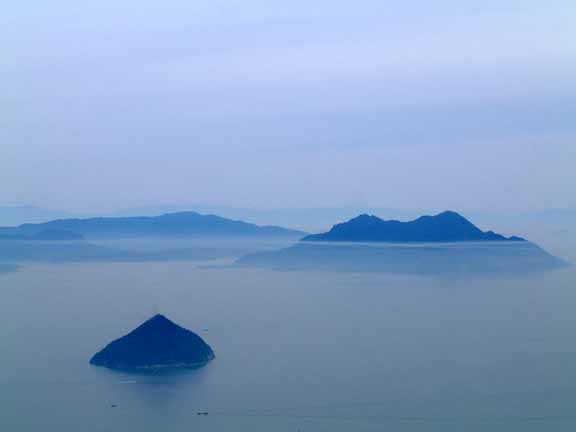
My own favorite among his books is The Inland Sea, a travelogue that recounts Richie's journeys among the islands and villages that surround Japan's great interior ocean.  With a handful of other books--Bruce Chatwin's In  Patagonia, Rebecca West's Black Lamb and Gray Falcon, Rose Macaulay's The Towers of Trebizond, and Michael Arlen's Passage to Ararat, Richie's book transforms the genre of travel writing to create a literary work of great intelligence and sensitivity--a book that is as much about Richie's inner life as about the lives of the people he encounters between the great islands of Shikokoku and Honshu.


"If I were to tell a Japanese that [something] is very beautiful, he would ask what is beautiful, and I would select the clouds or the far islands or else say that everything is beautiful. In Japanese it is always something that must be beautiful. Though the language has many abstract nouns, I have rarely heard the one for 'beauty.'

"Beauty is then not a state, but a quality. It is like strength or width or weight. It implies that there are many kinds of beauty--not just one ideal beauty. Everything is real; therefore everything has its own form of beauty, and beauty exists in it and not outside it.
"Beautiful islands, beautiful sea, beautiful sky--a whole world of varied beauty."


The Inland Sea, is now available from Stone Bridge Press
http://www.amazon.com/Inland-Sea-Donald-Richie/dp/1880656698

George Ovitt (2/22/13)


Thursday, February 21, 2013

"I am not here to write, but to be mad"

A Walk with Robert Walser  (1878-1956)


He loved to walk--he died in the snow on a stroll--was dapper, lonely (or not), wry and melancholy, Kafkaesque (though the influence ran the other way), intimate with the oddities of life, funny, and, in the end, perhaps, a little mad.  "I am a little worn out, raddled, squashed, downtrodden, shot full of holes. Mortars have mortared me to bits.  I am a little crumbly, decaying, yes, yes. That's what it does to you. That's life."("Nervous")  Indeed life does just that: it wears you out.  Walser is the great poet of fatigue, which is to say he does for ordinary life what urban intellectuals like Baudelaire or Benjamin did for ennui--he showed that fatigue is the human condition.

In my favorite picture (he was often photographed, even in death), Walser resembles my father, who was himself a low-level clerk (Walser scrapped together a precarious living selling his writing; he moved often; lots of his stories deal with lodgings and landladies).  "He goes for a walk. Why, he asks himself with a smile, why must it be he who has nothing to do, nothing to strike at, nothing to throw down?" ("Kleist in Thun")  "With a smile," so the question is this: is he really asking, or is he affirming?  That's the way it is with Walser's novels and especially with the short pieces--one can hardly call them stories: they are interludes--is our walker asking a question, inquiring into life, or does he know the answer already, does he know why he has "nothing to do" and wants merely to probe the dimensions of that "nothing"? 

"As I looked on the earth and air and sky the melancholy unquestioning thought came to me that I was a poor prisoner between heaven and earth, that all men were miserably imprisoned in this way, that for all men there was only the one dark path into the other world, the path down into the pit, into the earth, that there was no other way into the other world than that which led through the grave."

In Walser, such somber reflections quickly give way to other feelings--often to self-mockery, or to affection for some undistinguished person, or to disdain for the pompous.  Walser is flighty, his prose style rolls from formal diction and syntax--almost a parody of academic writing, stilted and dense--to breezy wit and heavy irony.  The long story "The Walk" traipses through landscapes and moods suggestive not so much of Kafka as of Pessoa, as if Walser's narrator was reinventing himself in time with the slowly passing urban and rural scenery.  If Walser were a wine, his label might direct the imbiber to search for overtones of Kafka and Klee (rectilinear miniatures going nowhere), of W.G. Sebald (wandering in blasted landscapes), and of the shape-shifting Pessoa, especially as encountered in the Book of Disquiet.

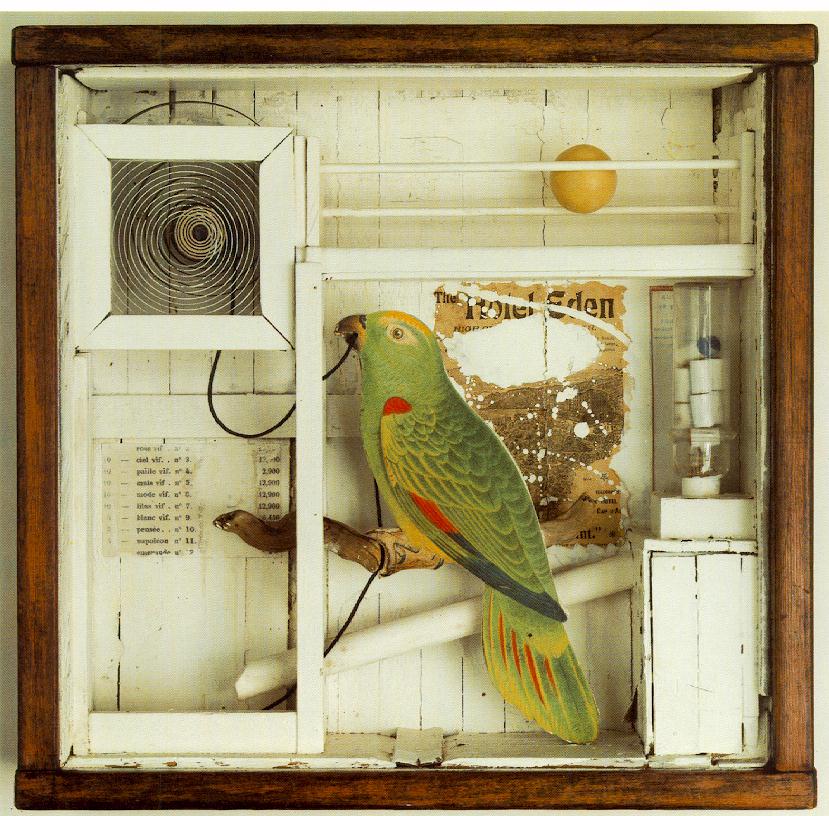
So long as we are playing this game--who does the writer remind me of?--my vote must be cast not for a writer at all, but for Joseph Cornell, the assembler of boxes, little collages cleverly done up from tattered bits of the discarded refuse of New York, cast off icons of modern life gathered together and assembled in Cornell's workroom on Utopia Parkway.  Walser's small pieces of prose are like little boxes that assemble impressions, memories, nostalgia, and, as with Cornell, a sweet, unrepentant  sadness almost never encountered any longer.


Untitled (The Hotel Eden)c. 1945 (140 Kb); Construction, 15 1/8 x 15 3/4 x 4 3/4 in; National Gallery of Canada, Ottawa


Walser was a  graphomaniac--he lived to write, or perhaps he wrote to live.  A selection of  twenty-five of Walser's  microscripts was published in 2010 by New Directions.  Even after his hospitalization in 1933 at Waldau, Walser continued to write stories in a hand so tiny an entire text "could be written on the back of a business card."  Appropriate, as the tiny German letters recreate worlds that are themselves miniatures of this world--"a clairvoyant of the small" was Sebald's judgment, and it is an incisive one.

 But of course, as with Cabala, everything in the universe is contained in even one letter of the Secret Books.  So it is with Walser.  In his miniature studies of eccentrics ("Kienast was the name of a man who wanted nothing to do with anything"), oddities ("The Man With the Pumpkin Head"), and, of all things, trousers, Walser demonstrated that something can be said about nearly anything, and that, in the end, what is said amounts to nothing.

Robert Walser, Selected Stories, with an introduction by Susan Sontag, New York Reivew Books

J.M. Coetzee has written a fine essay on Walser, focused on two of Walser's novels, in the New York Review of Books.

http://www.nybooks.com/articles/archives/2000/nov/02/the-genius-of-robert-walser/?pagination=false

George Ovitt (2/21/13)


Sunday, February 17, 2013

Palestinians at Sea


The Ship (al-Safīnah)
by Jabra Ibrahim Jabra

The ‘ship of fools’ has been an important allegory in Western art and literature for at least five hundred years. Typically involving a pilotless ship packed with fools of every kind, it is the story of a journey to nowhere, an apologue, a parable, that has been traced to actual practice in Renaissance Europe. As described by Michel Foucault in his book Madness and Civilization, there was a tradition—no one knows how rare or widespread—of ridding a city of its lunatics by crowding them onto a ship then turning it out to sea.  


I first really learned of this allegory when I happened upon a copy of Katherine Anne Porter’s 1962 novel, Ship of Fools, a story about a motley collection of Mexicans, Germans, Americans, and Jews bound from Veracruz, Mexico, aboard a German freighter called the Vera, to Europe on the eve of World War II—a journey to nowhere indeed! Clearly Jabra Ibrahim Jabra had something similar in mind when he wrote The Ship, if with some bold and compelling variations. Set shortly after the creation of the State of Israel in 1948, what Palestinians refer to as ‘The Catastrophe’ (النكبة, an-Nakbah), the novel follows an assortment of Palestinian exiles—writers, professors, artists, and intellectuals, as well as a smattering of Lebanese, Iraqis, and Europeans—on a journey aboard the passenger ship Hercules as it plies the Mediterranean en route to London.  Drinking, dancing, debating, declaiming, the travelers pass their days in a state of restless limbo, a sort of floating Purgatory between East and West, neither here nor there.  Into this crucible Jabra pours all of the hopes and dreams, all of the anger, frustration, and despair of the Palestinian people, as well as that of the Arab world itself.  According to translators Adnan Haydar and Roger Allen, “Palestine is the microcosm of the Arabs’ defeat, of their failure to determine their destiny in their own lands.  The fall of Palestine in not an incidental event; it is the tragic fall of the whole Arab world, a product and a result of Arab acquiescence in a reality before which they are helpless.  Palestine is the land, the soul to be reclaimed…” 

What is so striking about Jabra’s novel, The Ship, about his particular version of the allegory, is that for all its nods to the West, its rich and numerous allusions to classical Greece and nihilism, to Bach, Freud, Goethe, Balzac, Eliot, Le Corbusier, Dostoevsky, Kafka, and Thomas Aquinas, the novel hardly feels Western at all.  For we read also—and to equal effect—of Ibn al-Arabi, Ahmad Shawqi, and the Arab history of Palestine, hear the haunting, incomparable voice of Umm Kulthum. Told from a variety of perspectives, in a series of dramatic, sometimes internal monologues, the novel feels far more like a modern version of Tales from the Thousand and One Nights than a remaking of Porter’s Ship of Fools.  Distinctly Arab in style, distinctly Palestinian in longing and grief, the novel represents a dexterous bridging of East and West that springs directly from the identity of the author himself.  Born to a Syriac Orthodox Arab family in Bethlehem in 1919, Jabra Ibrahim Jabra came to be one of the finest ambassadors of his time between the Arabic and European worlds. Novelist, poet, translator, sculptor, painter, art collector, playwright, and critic, his work and interests knew no boundaries. Sadly, as noted by the late Anthony Shadid in a 2010 article for The New York Times,His [Jabra’s] secular notion of identity has withered before the ascent of sectarian and religious forces.  In an asymmetric conflict, at times cartoonish, an aggressive West faces a seething East.” 


Here, to round things out, is one of Jabra’s best-known poems:


In the Deserts of Exile

Spring after spring,
In the deserts of exile,
What are we doing with our love,
When our eyes are full of frost and dust?
Our Palestine, green land of ours;
Its flowers as if embroidered of women’s gowns;
March adorns its hills
With the jewel-like peony and narcissus;
April bursts open in its plains
With flowers and bride-like blossoms;
May is our rustic song
Which we sing at noon,
In the blue shadows,
Among the olive trees of our valley
And in the ripeness of the fields
We wait for the promise of July
And the joyous dance amidst the harvest.
O land of ours where our childhood passed
Like dreams in the shade of the orange-grove,
Among the almond-trees in the valleys—
Remember us now wandering
Among the thorns of the desert,
Wandering in rocky mountains;
Remember us now
In the tumult of cities beyond deserts and seas;
Remember us
With our eyes full of dust
That never clears in our ceaseless wandering.
They crushed the flowers on the hills around us,
Destroyed the houses over our heads,
Scattered our torn remains,
Then unfolded the desert before us,
With valleys writhing in hunger
And blue shadows shattered into red thorns
Bent over corpses left as prey for falcon and crow.
Is it from your hills that the angels sang to the shepherds
Of peace on earth and goodwill among men?
Only death laughed when it saw
Among the entrails of beasts
The ribs of men,
And through the guffaw of bullets
It went dancing a joyous dance
On the heads of weeping women.
Our land is an emerald,
But in the deserts of exile,
Spring after spring,
Only the dust hisses in our face.
What then, what are we doing with our love?

When our eyes and our mouth are full of frost and dust?


*Translated by Mounah Khouri and Hamid Algar

Jabra Ibrahim Jabra (1920 – 1994) (Arabic: جبرا ابراهيم جبرا) was a Palestinian author born in Bethlehem at the time of the British Mandate. Educated in Jerusalem and, later, at Cambridge University, he settled as an exile in Iraq, in Baghdad, following the creation of the State of Israel.  An internationally renowned writer, artist, and cosmopolitan, he distinguished himself in the Arab world with his critically acclaimed  translations of Shakespeare, Chekov, Eliot, Beckett, Faulkner, Camus, Wilde, James Frasier, La Fontaine, Edmund Wilson, and Dylan Thomas.  The Ship is published by Three Continents Press.  Also noteworthy is Jabra’s novel In Search of Walid Masoud published by Syracuse University Press.
Note: The house that Jabra built in Baghdad (complete with his beloved orange trees, library, and art collection), a home in which for more than forty years he played host and mentor to artists, writers, and intellectuals from around the world, was destroyed in a car bomb attack in 2010.


*Photograph of Jabra’s house by Holly Pickett for The New York Times
* Detail of painting ‘Ship of Fools’ by Hieronymus Bosch (painted c. 1490–1500)

Peter Adam Nash

Friday, February 15, 2013

Hallucinations: Céline and Antunes


Young men with guns: look in the pages of the New York Times any morning and you will see an image like the one above (actually a photograph  taken in Angola in the 1970's).  There is nothing to say about such images, about such realities, any longer.  All that is left is to ascribe the image, the  violence, to the realm of nightmares.  There is no longer anything to learn about these images, these young men--they are only to be discussed by madmen. 

In 1916, Louis Ferdinand Auguste Destouches, better known to us as Louis-Ferdinand Céline, set out for what were then known as the Cameroons, in French West Africa.  He spent one year in Africa, but wove that year into his debut novel, Journey to the End of the Night (1934), a  hallucinatory voyage through the First World War, European imperialism in Africa, immigrant life in New York, and despair in Paris.  I have chosen this passage more or less at random:

"What I [Bardamu, Celine's alter ego and anti-hero] couldn't help hearing under their spoken words and expressions of sympathy was this: 'Nice little soldier boy, you're going to die...You're going to die...this is war...Everyone has his own life...his role...his death...We seem to share your distress...But no one can share anyone else's death...A person sound in body and soul should take everything that happens as entertainment, neither more nor less, and we are wholesome young women...You'll soon be forgotten, dear little soldier boy..."

What does hallucinatory really mean, in relationship to literature?  I read Celine as a writer who is recreating dreams, states of consciousness that are offered without editing, where the extraneous is pushed front and center, where the reader's patience is tried by a lack of causality, coherence, and even, at times, of meaning. But then how else should a serious writer represent the horrors of the twentieth century but as a waking nightmare?

Among the most horrid nightmares of the Cold War occurred not in Latin America (there were plenty there) or Eastern Europe, but in Africa, in Angola in particular, a nation torn in three by the Portuguese--the original colonists--the Russians and the Americans, with the Chinese waiting in the wings for whatever scraps of diamonds and domination were left over. I won't recapitulate this history here, but only mention that the great Portuguese novelist, Antonio Lobo Antunes, served both his medical and literary apprenticeship in the horrifying war that pitted the Marxist government (supported by Cuban and Russian men and arms) against the U.S.-backed UNITA movement led by the charismatic madman Jonas Savimbi, one of the darling psychopaths of the Reagan administration.  Antunes, born in 1942, served a medical apprenticeship in Angola, and witnessed scenes of horror that have pervaded his fiction ever since.  His stylistic and tonal affinities with Celine are apparent, but his voice is his own--in the great novel Os Cus de Judas (The Asshole of Judas) translated by Margaret Jull Costa as The Land at the End of the World  (1979)--the mad, rambling, hallucinating narrator relates his experiences in the horrifying Angolan Civil War that eventually claimed the lives of half a million Angolans:

"No, I mean it, dusk falls and my heart starts to pound, I can feel it in my pulse, there's a tightening in my stomach, my bladder hurts, my ears hum, as if some indefinable thing waiting to burst forth were throbbing inside my chest: one of these days, the porter will find me lying naked on the bathroom floor, toothpaste and blood dribbling from one corner of my mouth.....I know it was six years ago, but I still get upset: we were traveling in convoy along sandy roads from Luso down to the Land at the End of the World, Lucusse, Luanguinga, past troops guarding the road construction site, past the ugly, uniform desert, villages surrounded by barbed wire, the prefabricated buildings of the barracks. . . . .my cap pulled low over my eyes, an endless cigarette vibrating in my hand, I began my painful apprenticeship in dying."


The hallucinatory is the dream made real. Antunes has a predecessor in Céline to be sure, but also in Coleridge's Ancient Mariner, in Conrad, and in Faulkner, all of  whose narrators share with Antunes's doctor an obsession with the hopelessness of rendering into language that which is unspeakable. 

The victims of more recent colonial wars in Vietnam, Iraq, and Afghanistan will recognize at once the madness of Atunes's doctor-narrator as the inevitable outgrowth of war's horror.  We call the syndrome PTSD and apply the term to any sort of trauma, but the victims of war suffer more than trauma--they lose their identifty altogether:

"I am today whom I deep down reject: a melancholic bachelor whom no one phones and from whom no one expects a call, who coughs occasionally just to feel as if he had company, and whom the cleaning lady will find one day sitting in his rocking chair in his undershirt, mouth agape, his purple fingers trailing on the November-colored hair of the carpet."

Antunes is the author of over twenty-six novels and is widely considered to be Portugal's greatest living novelist. 

The Land at the End of the World is published by W.W. Norton.


George Ovitt (2/15)


Thursday, February 14, 2013

Witness

The Selected Poems of Mario Benedetti    


"The spirituality of work. Works make us experience in the most exhausting manner the phenomenon of finality rebounding like a ball; to work in order to eat, to eat in order to work. Workers need poetry more than bread. They need that their life should be a poem."
   Simon Weil, "The Mysticism of Work"


We may forgive the saintly Weil for exaggerating: workers need bread more than poems, but we do need poems and we need poets.  Among the poets whose sensibility includes work--its glories and trials and beauty--is the great Uruguayan, Mario Benedetti, who died in 2009, and who was among a handful of the most prolific, popular, and versatile of Latin American writers of the 'boom' period, the "generation of 1945" in Uruguay, that hopeful post-War, liberal moment of Latin American history that was crushed--in Uruguay, Nicaragua, Cuba, Guatemala, El Salvador, and elsewhere--by the bipolar hostilities of the Cold War. 

Benedetti, born of Italian immigrant parents in Pasa de los Toros, "Was a man of the left who criticized the United States, championed Cuba’s revolution, embraced independence for Puerto Rico and, in 1971, helped organize a left-wing coalition in Uruguay called the Broad Front to challenge the two-party system that had prevailed for nearly 150 years."* Like many other Latin American intellectuals and progressives, Benedetti was forced into exile; banned from the United States, he lived in Argentina, Peru, Cuba, and Spain, before returning to his beloved Montevideo, in 1985.

I first read Benedetti, in Spanish, while living in Nicaragua in the 1980's.  A friend gave me one of Benedetti's many books--Viento del exilio--that I could barely make out.  Benedetti's Spanish is lively and idiomatic and attuned to the speech patterns of ordinary people--it is difficult to translate, but thanks to Louise B. Popkin and the good people at Buffalo's White Pine Press, we now have a generous, lucid, and accurate version of some of Benedetti's poems--he was enormously prolific, publishing eighty books, including poetry, plays, song-lyrics, and many novels (which I hope Ms. Popkin will consider translating as well). 

I love poets who are engaged with the world, whose political passion informs their writing.  We have few such poets in North America, and their work is generally marginalized in our search for the merely entertaining and our discomfort with art that doesn't affirm our way of living and thinking.   But Mario Benedetti's work demonstrates the richness of poetry that derives its life from this world, with us, the poetry of workers and of ordinary people who need bread and poems:

In this everyday poem I miss autumn
   with its permanent radiance
that golden sun encircling the pines
   and highlighting their majestic stillness
a certain aroma of boulevards taken over
   by dead leaves and grapes for sale
and of young girls digging their woolens
   out of mothballs.
[y tambien a muchachas que exhumaban sus prendas/de lana y naftalina], from Everyday Poem 4/20

Benedetti wrote some lovely poems to his wife, Luz, to whom he was married for half a century:

We've arrived at at neutral twilight
where day and night melt into sameness.
No one can ever forget this interlude.
The sky glides smoothly over my fallen lids,
emptying the city from my eyes.
Don't think now of time on the clock,
the time of petty sorrows,
Now there's only naked yearning [el anhelo desnudo]
the sun breaking free of its weeping clouds,
your face fading into the night
until it's but a voice and the whisper of a smile.
  [from Taking Hold of You]

My favorite Benedetti poems celebrate ordinary life:

From time to time joy
tosses pebbles at my window [!]
so I'll know it's out there waiting
but since today I'm feeling calm
I'd almost say cool-headed
I plan to stash my cares away
stretch out and look up at the ceiling
which is a fine comfortable position
for sifting out news and letting it sink in

who knows where my next steps will lead me
or when the measure of my life will be taken
who knows what words of caution I'll yet come up with
or what shortcuts I'll take to ignore them....[from Pebbles at My Window]

Like all great poets, Benedetti is not for the day, or the mood, or the cause, or the single idea--his poetry touches on the beauty of a life lived with passion, on politics and marriage, on joy and the great sorrow of exile.  He can write poems of grief and rage--as in "At Dream Level"--and then shift gears to meditate on hope, however fragile: "Hope so gentle/so polished so sad/a vow so lightly taken/is not my way/hope so docile/is not my way/rage so meek/so humble so weak/anger so discreet/is not my way/...my way is your gaze/so giving yet firm/your silence so guileless/is my way...." [My Way]

"We've arrived at that neutral twilight/where day and night melt into sameness./No one can ever forget this interlude...."

Witness: The Selected Poems of Mario Benedetti, trans. by Louise B. Popkin, with a (loving) introduction by Margaret Randall, published by White Pine Press, a great source for excellent poetry.
http://www.whitepine.org/

*New York Times obituary, May 19, 2009.

George Ovitt (2/14/13)


Wednesday, February 13, 2013

Dream Deferred


The Street by Ann Petry

Harlem


What happens to a dream deferred?

Does it dry up
like a raisin in the sun?
Or fester like a sore—
And then run?
Does it stink like rotten meat?
Or crust and sugar over—
like a syrupy sweet?

Maybe it just sags
like a heavy load.

Or does it explode?
                        Langston Hughes

There was a cold November wind blowing through 116th Street.  It rattled the tops of garbage cans, sucked window shades out through the top of opened windows and set them flapping back against the windows; and it drove most of the people off the street in the block between Seventh and Eighth Avenues except for a few hurried pedestrians who bent double in an effort to offer the least possible exposed surface to its violent assault.

It found every scrap of paper along the street—theater throwaways, announcements of dances and lodge meetings, the heavy waxed paper that loaves of bread had been wrapped in, the thinner waxed paper that had enclosed sandwiches, old envelopes, newspapers.  Fingering its way along the curb, the wind set the bits of paper dancing high in the air, so that a barrage of paper swirled into the faces of the people on the street.  It even took time to rush into doorways and areaways and find chicken bones and pork-chop bones and pushed them along the curb.


Cold, gritty, impersonal.  Such is the atmosphere created by Ann Petry in the opening pages of her extraordinary novel The Street.  Set and published in the immediate wake of WWII, the story follows Lutie Johnson, a strong and beautiful African-American woman, in her struggle to gain a foothold—a little peace and security—for her and her eight-year-old son, Bub, amidst the poverty, racism, sexism, and violence of 1940’s Harlem. By the time the story takes place, the great Harlem Renaissance, with its groundbreaking artists, writers, and musicians, with its headlong devotion to civic participation, political equality, and economic and cultural self-determination, is for many, like Lutie Johnson, but a figment of the past. Her life is defined instead by the Great Depression, which—at the time of this story—still casts its shadow over Harlem. ‘Last hired, first fired,’ African-Americans were hit even harder by the Depression than most. At the Depression’s height, 25 percent of Americans had no jobs. In Harlem the rate was as high as 50 percent, tapering off only gradually during the war and in the immediate post-war years.[i]  Harassed, all but consumed by worry in her daily effort to provide a life for her and her son, Lutie Johnson is haunted daily by reminders of the American Dream and its promise to those who work hard, the prospect of her fulfillment as a woman and mother in Harlem but a cruel and mocking mirage.


Described without a trace of sentimentality or self-pity, in a lucid, hard-edged prose, The Street retails the deeply moving struggles of an African-American woman battling the odds in her effort to defy the fate that stalks her.  “Written with cool anger,” writes a critic from Newsday: “The Street rushes toward its fatalistic climax like a train toward a washed-out bridge.”

Ann Petry (1908-1997) was an African American writer most famous for her novel, The Street, a hard-hitting social commentary on black urban life in the 1940s.  Published in 1946, the novel sold 1.5 million copies and brought Petry to national attention. The impact of Petry’s writing continues to be appreciated: literary critics praise her as the most successful follower of the 1940s “Richard Wright school” of urban protest writing; and black feminists cite The Street as the first African-American novel in which motherhood is a major theme. In addition, black feminists commend Petry for showing through The Street ‘s main character, Lutie, that a lack of connection to self and community can result in one’s downfall. (FemBio: Notable Women International)

Also recommended: Miss Muriel and Other Stories, Dafina Press

Painting by William H. Johnson

[1] Cheryl Lynn Greenberg, professor of history at Trinity College and author of “‘Or Does It Explode?’: Black Harlem in the Great Depression,” as well as the forthcoming “To Ask for an Equal Chance: African Americans During the Depression.”

Peter Adam Nash