Friday, March 8, 2013

Dutch Tao


The Ten Thousand Things

by Maria Dermoût

“When the ten thousand things have been seen in their unity, we return to the beginning and remain where we have always been.”  It is with this epigraph from the great Tang dynasty poet, Ts’en Shen (618–907), that the Java-born Dutch writer, Maria Dermoût, sets the tone for her uncanny, ethereal novel The Ten Thousand Things.  Set, near the dawn of the last century, on one of the Spice Islands in the  Dutch East Indies (now Indonesia), the story—at points but a gossamer tangle of threads—follows the life of a woman named Felicia who, after a long absence, has returned to the East Indies from Holland with her son, to the house and garden where she was born and raised.  There, with affection, with patience, she teaches him about ‘the ten thousand things’. It is near the tail-end of this darkest chapter of Dutch imperial history, that Dermoût begins this gentle, truly wondrous tale—a paean, a plainsong, to the Spice Islands she loved, to its people, animals, and plants, and to the spirits that haunt that lush and tortured land. Hers is a world steeped in myth and mystery, an experience at once intangible, elusive, and deeply, resoundingly clear.  Of the novel, Dutch author Oek de Jonge writes: “It possesses something that wards off hordes of readers, yet still manages to attract a handful, who then embrace it and spread the word of its exquisite nature. The shell seekers among the readers, the slow walkers, those who stop and turn and bend over to pick up that one beautiful shell—they recognize her extraordinary work.”


Maria Dermoût (Helena Anthonia Maria Elisabeth Dermoût-Ingerman) Dutch novelist and short-story writer known for her subtle and evocative portraits of colonial life in the Dutch East Indies was born June 15, 1888 in Pekalongan, Java, Dutch East Indies and died June 27, 1962 in Noordwijk, Netherlands.  Dermoût, who was the descendant of employees of the Dutch East Indies Company, spent her childhood on a sugar plantation in central Java. She attended school in the Netherlands but returned to the islands as a young wife and remained there most of her life.

Her work was not published until she was in her 60s. Her first two novels, Nog pas gisteren (1951; Yesterday) and De tienduizend dingen (1955; The Ten Thousand Things), are fictionalized accounts of her youth. Although written in an economic style, the two novels are rich in details of island life as experienced by both the colonials and the native people. Among Dermoût’s other books are three volumes of short stories: De juwelen haarkam (1956; “The Jeweled Haircomb”), De sirenen (1963; “The Sirens”), and De kist; en enige verhalen (1958; “The Wooden Box: A Unique Account”), as well as a book of sketches, Spel van Tifagongs (1954; “Tifagong’s Play”). Her work is critically acclaimed not only for its clarity but for its sensitive account of colonialism coexisting with a lush, primitive beauty and power.* The Ten thousand Things is published by New York Review of Books Classics.   http://www.nybooks.com/books/imprints/classics/

*Encyclopedia Britannica

Peter Adam Nash


Wednesday, March 6, 2013

Lovers of the Lost

Poems by Wesley McNair


     If, dear reader, you are anything like me, you have tidy (or not) piles of books in strategic locations around the house--in the bathroom (Hegel, Kierkegaard, and Heidegger),  something in the kitchen to pass the time while the water boils (Machado's poems--brief enough to rescue the pasta before it boils over), the main-reading-chair (an overly-ambitious, disorganized, and ever shifting mountain of books, newspapers, journals, tea cups and half-eaten sandwiches),and, most importantly, at the bedside. The pile next to the bed (or on a table if you happen to have one; I don't) is the central pile, the one whose content, size, arrangement, and at-handedness are essential to the bibliophile's happiness and survival. I spend a great deal of time on my bedside pile and have various categories of literature arranged there: one or two mysteries by George Pelecanos for long, insomniac nights; two or three serious novels (Antal Szerb's Journey by Moonlight, Boleslaw Prus's The Doll, and Christie Watson's Tiny Sunbirds, Far Away at the moment); and some poetry, usually the poets I never tire of reading: William Matthews, Stephen Dunn, Wallace Stevens, Kay Ryan, and, right now, Wesley McNair, a new addition to my bedside reading, a poet I have come to enjoy immensely. I wanted to take a minute to share some of his work with others who are attracted to a certain kind of understated, sardonic view of the human condition. Meet Mr. McNair:


How I Became a Poet


"Wanted" was the word I chose
for him at age eight, drawing the face
of a bad guy with comic-book whiskers,
the showing it to my mother. This was how
after my father left us, I made her smile
at the same time I told her I missed him,
and how I managed to keep him close by
in that house of perpetual anger,
becoming his accuser and his devoted
accomplice. I learned by writing
to negotiate between what I had,
and that more distant thing I dreamed of.

Those last lines are perfectly pitched--anyone who writes knows the feeling of moving between what one has, or is, and what one dreams of; the poignancy is greater here as McNair imagines himself at eight, trapped between yearning and anger, absent father and beloved parent.

Wesley McNair is the author of nine books of poetry, the poet laureate of Maine, and the recipient of numerous awards. He has also written four books on the craft of poetry, including a fine book entitled Advice for Beginning Poets. My personal favorite among his books of poetry is Fire, from 2002. I love his wit, his sadness, his fine eye for the commonplace (the poem "Love Handles" is among my favorites)--many of his poems recount a difficult childhood in what used to be called a 'broken' home but is now simply a home.
 
Wesley Mcnair
 

As I Am


Behind my false beard
and the frown line between
the eyebrows I have have developed
by trying to pay attention
to the world, I am the same kid
who could never remember
his library books or what
he had been sent to the store for.
"Fog" was the name my teachers
gave to where I spent my time,
a haze that even today
can descend while I'm having
a conversation, or suddenly lift,
revealing the wrong
landmarks drifting past me
on the wrong road I took ten
miles ago. God, it has been lonely
to turn up all these years
where everyone else has arrived
long since. Yet how, without
looking just beyond
the shoulders of others
as they spoke, or searching
everywhere for the pen
I found in my own hand,
could I concentrate on the thought
I learned to write down
at last, back from the place
that has wanted me off-course
and bewildered, just as I am.


The book I am now holding is one of those beautiful David R. Godine paperbooks--heavy, creamy paper, clear fonts, Edward Hopper's Cape Cod Morning for a cover. A book I love to pick up when I first climb into bed; I open it, and come upon this gem:


Why We Need Poetry

 
Everyone else is in bed, it being, after all,

three in the morning, and you can hear

how quiet the house has become each time

you pause in the conversation you are having

with your close friend to take a bite

of your sandwich. Is it getting the wallpaper

around you in the kitchen up at last

that makes cucumbers and white bread, the only

things you could find to eat, taste so good,

or is it the satisfaction of having discovered

a project that could carry the two of you

into this moment made for nobody else?

Either way, you're here in the pleasure

of the tongue, which continues after

you've finished your sandwich, for now

you are savoring the talk alone--how

by staring at the band of fluorescent light

over the sink or the pattern you hadn't

noticed in the wallpaper, you can see

where the sentence you've started, line

by line, should go. Only love could lead you

to think this way, or to care so little

about how you speak, you end up saying

what you care most about exactly right,

each small allusion growing larger

in the light of your friend's eye.

And when the light itself grows larger,

it's not the next day coming through the windows

of that redone kitchen, but you,

changed by your hunger for the words

you listen to and speak, their taste

which you can never get enough of.

 
I can't claim to know Maine well, but I do know Vermont; there at least speech proceeds largely through misdirection, allusion, and long, at times painful, silences. McNair has the gift of leading slowly to the point: "Only love could lead you/to think this way..." such a quietly powerful line after the build-up of work and sandwiches and talk. And, like the metaphysical poets--or, like Dunn, Matthews, and Ryan--McNair performs with ease the trompe d'oeil of placing the unexpected in the middle of the everyday--the you that is changed by the "hunger for words" filling the kitchen, and not the morning light.

http://www.godine.com/ For this and other fine works of fiction and poetry.


Sunday, March 3, 2013

"But now the thread of imagination abruptly snapped"


Basti by Intizar Husain


"The sound of slogans being shouted outside suddenly penetrated the room and scattered his memories in all direction."

This magical, tragic novel of Pakistan, written by the consensus greatest living writer of Urdu, Intizar Husain, traverses the history of the basti, the settlement, of Pakistan from the mythic era to the modern, from pre-Partition to "the burning city," to the time of signs.  The central figure, Zakir--"he who remembers"--is at first a boy living in a kind of cosmopolitan golden age of non-sectarian peace and cooperation: "When the world was still all new, when the sky was fresh and the earth not yet soiled....."  This is the world all of us remember, the one before now, not a real world at all, but the child's perfect vision of what could be, or should be: "What holds the earth steady?"  Stories, and families, and young love....

But of course such an idyllic existence is just a child's dream, and "processions" of violence, sectarianism, and disillusionment fill most of the novel, though indirectly.  Husain's style is oblique and subtle--in a society where men sit for hours in tea shops chatting amicably about subjects that often mask the true subject, where politics is shrouded in metaphor and misdirection, it is sometimes difficult to perceive the ways in which the world outside intrudes upon the world within:

     "Where did the bomb fall? The various lanes of the city rise up in my imagination. I try to guess from which direction the sound of the explosion came, and which neighborhoods are located in that direction.  Abba Jan is entirely absorbed in reading from the Quran, and my mind is wandering through the various lanes of the city. In Shamnagar I suddenly pause. That house is Shamnagar where we camped when we first came to Pakistan rises up in my imagination. Has the bomb fallen there? No, it shouldn't fall there. I have no emotional relationship with that house. The moment we left it, the house slipped out of my memory without leaving any imprint on my heart or mind...that house ought to be safe."

An indoor book, Basti studies human settlements on a microcosmic scale--not nations and cities, but rooms and houses and shops.  Not great ideas about religion, but daily devotions; not economic theory, but quiet tasks (Zakir is a history teacher--who else would remember anything?), not war between India and Pakistan, but disagreements among neighbors.  Basti's scale is small and imbued with magical thinking--the past obtrudes on the present in just the way the old buildings of British occupation fill the spaces of the new settlement of refugees from India.


Resolutely modernist in structure and tone, Basti moves quickly back and forth in time, from myth to history, from the psychological to the physical; Husain employs various narrative devices--interior monologue, diary entries, long snatches of dialogue in which speakers remain unidentified, direct description--in order to create a vibrant, dynamic story, one that mirrors the uncertainties and transformations of the place and time it describes.  Basti is a book that frustrates, not in the art of it, which is nearly perfect, but in the constant thwarting of expectation--love, friendship, politics, all rise up and are then, one by one, brushed aside.  Like the street marches that pass by the tea shop, the characters move but make no progress; time passes but toward what end?

     "Why are you silent?" Irfan was gazing steadily at him.
     "Silence." Afzal, placing a finger on his lips, signaled Irfan to be silent. "I think we will see a sign."
      "A sign? What sign can there be now?" Irfan said with bitterness and despair.
      "Fellow, signs always come at these times, when all around--" he paused in the middle of his speech. Then he said in a whisper, "This is the time for a sign--


And the novel ends.  What is the sign, and when will it come?

"Intizar Husain (b. 1925) is a journalist, short-story writer, and novelist, widely considered the most significant living fiction writer in Urdu. Born in Dibai, Bulandshahr, in British-administered India, he migrated to Pakistan in 1947 and currently lives in Lahore. Besides Basti, he is the author of two other novels, Naya Gar (The New House), which paints a picture of Pakistan during the ten-year dictatorship of the Islamic fundamentalist General Zia-ul-Haq, and Agay Sumandar Hai (Beyond Is the Sea), which juxtaposes the spiraling urban violence of contemporary Karachi with a vision of the lost Islamic realm of al-Andalus. Collections of Husain’s celebrated short stories have appeared in English under the titles Leaves, The Seventh Door, A Chronicle of the Peacocks, and An Unwritten Epic." [from the New York Review of Books]


Basti, translated by Frances W. Pritchett, with an introduction by Asif Farrukhi, is published by New York Review Books
http://www.nybooks.com/books/imprints/classics/basti/

George Ovitt (3/3/13)


Friday, March 1, 2013

Pavese: Love and the Abyss


Stories by Cesare Pavese  (The Ecco Press)

In the first Pavese story I ever read, a story called “Wedding Trip,”  completed on December 6, 1936, the narrator—a newly married man named George—stands, with his young wife, Cilia, by the Genoa harbor at night, the only night they could afford for their honeymoon, and feels the darkness closing in upon them. “We came to the railings of a terrace and caught our breath.  The night was calm but dark, and the street lamps floundered in the cold abyss that lay before us.” For Pavese this darkness, this abyss, as perceived by the narrator, is not simply hyperbole, a figure of speech designed to intensify the mood, nor is it merely the aggravated projection of a newly married man, pinched with mourning for his bygone bachelor days, but a stark and telling measure of Pavese’s own special dread. 

All of the stories in this collection, the ones for which Pavese is most widely known and admired, were written in the shadow of Italian and German fascism, a period—dating roughly from 1936 to 1945—that marked a kind of Dark Ages for Italian intellectuals, artists, and writers, like Pavese.  Surely this was a part of his dread. Under Mussolini, the parliamentary system was abolished, all teachers in schools and universities had to swear allegiance to the fascist regime, and freedom of the press was strictly curtailed.  Pavese himself was summarily convicted of antifascist activities and sentenced to a year of ‘preventative detention’ in 1935 for a series of articles he had written as editor of a review called La Cultura.  After a few months in prison at Brancaleone Calabro, he was sent into ‘confino’ or internal exile in Southern Italy, the common punishment for those guilty of lesser political crimes, the same punishment suffered by fellow writers and Leftists,  Leone Ginzburg and Carlo Levi.  It was an experience—Pavese’s time in prison and exile—that wrought a significant change in him, scarring him psychologically and darkly coloring his work.

That, by the end of his life, Pavese hated women is a fact well-known to readers of his work. This too must be understood as a part of his dread. Plagued by depression and asthma, a tortured loner long-enamored of suicide, he suffered one failed relationship after another, first with a mysterious woman he met while at university known only by the phrase “la donna dalla voce rauca” (the girl with the husky voice), and finally with the beautiful American actress, model, and former mistress of Elia Kazan, Constance Dowling.  So intense was his love for Dowling, so turbulent their affair, that he never recovered from it, finally taking his own life in a hotel room in Turin. "Non scriverò piú," “I will not write anymore,” he concluded his diary that night, swallowing a mouthful of sleeping pills before climbing into bed.  One of his last poems, “Verra la morte e avra i tuoi occhi,” or “Death Will Come and Look at Me with Your Eyes” was written for Dowling with Dowling in mind:


Death will come and look at me with your 
         eyes-
the death that follows us around
from morning to night, insomniac, deaf,
like some stale, now irreparable guilt
or ridiculous habit. Your eyes
will be empty words,
a suppressed cry, a silence-
the way you see them each morning
when you lean toward yourself alone
in the mirror.                                    
         O dearest hope, on that day we too will know
that you were life, and you were nothingness.
For everyone, death has a certain look.
Death will come and look at me with your
         eyes. Then the habit will be given up,
we will see in the mirror
the dead face reemerging,
the sealed lips will have their voice.
And we, the silenced, go down into the abyss. 

(translated by Alan Williamson)

If Pavese felt tortured and betrayed by women, he felt tortured and betrayed by love itself, which he dreaded for the way it exposed him as a man. In his diary he wrote: "One does not kill oneself for love of a woman, but because love--any love--reveals us in our nakedness, our misery, our vulnerability, our nothingness." Indeed his stories and poems are replete with examples of what he came to see as the fundamental treachery of women, of love.  Still, Pavese’s need of and obsession with women is clear.  As Geoffrey Brock puts it in his thoughtful introduction to Pavese’s poetry, Disaffections: Complete Poems 1930-1950, “Most of the late poems are addressed to a female ‘you,’ who, while inspired by particular real-life women, tends to blur into an archetypal figure who is by turns, and sometimes simultaneously, attractive and repulsive.” 

Such is Pavese’s complexity when it comes to women, when it comes to his vision of life, that to simply dismiss him as misogynist is to miss the anguished, hard-won beauty of his work.  For while, in his story “Wedding Trip” (to take but one example), his narrator is relentless in his derision of his young wife, Cilia, resentful of her for the inadequacy that her love makes him feel, Pavese’s portrayal of her is neither that of succubus nor shrew. In contrast to him—the narrator, George—Cilia is radiantly human: tender, trusting, romantic. A haunting affirmation of life, she is all he longs for and dreads. Even in his story “Suicides,” in which the narrator’s callous behavior actually drives his lover, Carlotta, to take her own life, Pavese makes it clear, if only in the way he yields to gentleness and pity in his description of her, that the story’s life-force, its humanity, is hers

In this same story, the narrator reflects: “Long ago I realized how essential astuteness is to living, and before being astute with others one must be astute with oneself.” Pavese, the man, the writer, was nothing if not astute—with others, and above all with himself.  What is plain, what elevates these haunting, often pain-filled stories to the stature of art, is that Pavese himself was well aware of the fact that his much-professed hatred of women had less to do with women themselves than with his own insecurity and self-loathing. Cruel as his male characters can be, they remain defiantly human, tortured as they are by remorse, by regret, by longing—by all the “dark angles” of love they are blessed and burdened to know. 

As Brock concludes in his aforementioned introduction to Pavese, “Even when his subject is the turning inward, the work itself is a reaching out…” Complex, resounding, often deeply elegiac, Pavese's stories have survived him to do just that.

Cesare Pavese (1908-1950) was a novelist, short-story writer, and poet who, in 1950, one month before his death,  was awarded the Strega Prize, Italy’s preeminent literary award.  He was then at the height of his fame as a novelist and a Communist man of letters.  The youngest of five children in a lower middle class family of rural origin, Cesare Pavese was born on 9th September 1908 in S. Stefano Belbo. His father died when he was six. He went to school in Turin, studying at high school under Augusto Monti, a friend of Piero Gobetti and Antonio Gramsci, and a prominent figure in the anti-fascist Turin. He graduated in letters in 1932 with a thesis on Walt Whitman. During the same period he began working as a translator for the publisher Frassinelli, translating Moby Dick by Melville and Dark Laughter by Sherwood Anderson. It was through Pavese’s translations that most Italians of the period first became acquainted with the works Faulkner, Joyce, Stein, Dickens, Steinbeck, Dos Passos, and Defoe.  Most Italians first encountered Herman Melville, James Joyce, William Faulkner, Charles Dickens, Gertrude Stein, John Steinbeck, John Dos Passos, and Daniel Defoe in Pavese's translations Most Italians first encountered Herman Melville, James Joyce, William Faulkner, Charles Dickens, Gertrude Stein, John Steinbeck, John Dos Passos, and Daniel Defoe in Pavese's translationsSuffering from one of his recurrent fits of depression, Pavese committed suicide on 27 August 1950.

While Pavese’s short stories are only available from used booksellers like AbeBooks http://www.abebooks.com/ and Alibris http://www.alibris.com/, I also recommend The Selected Works of Cesare Pavese and The Moon and the Bonfires published by New York Review Books Classics, as well as Disaffections: Complete Poems 1930-1950 (English and Italian Edition) published by Copper Canyon Press.


Peter Adam Nash

Wednesday, February 27, 2013

Agnieszka Kuciak

Distant Lands: An Anthology of Poets Who Don't Exist


The idea of authorship should be unambiguous, and it mostly is--I am writing this, and such and such is my biography.  

But let's look a little more deeply--Who wrote the Republic?  Plato gets the credit, but was he merely recording the words of Socrates, or had he redacted his teacher's ideas to such an extent that they became his own?  One might argue that Chaucer's Canterbury Tales--a tour de force of literary ventriloquism--is replete with heteronymatic (?) figures: Chaucer supplies each of his speakers with a full-fledged biography in the 'General Prologue', and then writes tales in the voice, and with a diction and tone appropriate to that character (think of the Nun's Priest and his tale, a perfect marriage of tale to teller).   Or, sticking to the era of Chaucer for just a moment--who was William Langland, "author" of the great political poems collected as Piers Plowman? And what is the meaning of authorship in an age that valued plagiarism, that expected one author to copy the work of another? 

Then there is the question  of the pseudonym: are Dickens's Sketches by Boz (1836) an example of pseudonymous authorship, or was Boz a Dickensian heteronym? Was Józef Teodor Nałęcz Konrad Korzeniowski's decision to go with 'Joseph Conrad' the same sort of literary disguise as François-Marie Arouet's decision to become Voltaire?  I can't imagine Voltaire as having any other name, but I can see Conrad in Konrad and might be able to make the Polish leap.  Then what of Chloe Wofford or  Neftali Ricardo Reyes Basoalto--can we imagine them as other than Toni Morrison and Pablo Neruda?   Some pseudonyms seem almost an affectation--why Mark Twain when Sam Clemens was perfectly serviceable?--and others have a political or cultural purpose (George Eliot, or Howard O'Brien's sensible decision to become Anne Rice).  So: names are complicated, and when writers change their names they do so for a variety of reasons, not the least of which is to deflect attention away from themselves and toward their books.

The melancholy Dane Søren Kierkegaard bridges the gap between pseudonymous authorship and fully realized herteronymic writing: Johannes de Silentio, "author" of Fear and Trembling, has a different style and tone than the "Victor Ermita" of Either/Or, but neither pseudonym is attached to a literary figure possessing a fully developed biography; indeed, Kierkegaard goes so far in his autobiographical writings as to discuss his use of pseudonymous figures in his literary productions, thus making the pseudonyms superfluous (rather like the way in which we are told that "Benjamin Black is the pen name of John Banville"--what's the point, aside from a possible tax dodge?).


File:Pessoacopo.jpgThe greatest act of literary impersonation ever pulled off was Fernando Pessoa's, the man himself (I think) pictured here imbibing a bit of wine in his (and my) beloved Lisbon.  Some attribute to Pessoa eighty full blown heteronyms, but this is an exaggeration--if a heteronym requires a biography, a variant style, and even a psychological profile (as with Bernardo Soares, author of The Book of Disquiet) then I'd credit Pessoa with having created no more than twenty (!) literary stand-ins.  Pessoa wrote so much--with Proust, he is the greatest graphomaniac of the modernist era--that he needed to fob off some of his work on other selves, but, beyond the issue of overproduction requiring decentralization, the miracle of Pessoa's writing is that it appears that he became this roomful of other people. 
 
Which brings us, at long last, to the subject of this entry, the Polish poet and translator (from Italian to Polish) Agnieszka Kuciak.  I made the acquaintance of Ms. Kuciak a few years ago through reading a handful of poems of hers in Six Polish Poets (ed. by Jacek Dehnel, Arc Books), but have since come into possession of her second book Distant Lands: An Anthology of Poets Who Don't Exist (her first was Retardacja [Retardation]) thanks to the good people at White Pine Press.  Kuciak is a ventriloquist, a punner, a Pessoan creator of echoing voices--but she is also a delight straight up, as here:
 
The Lyric Poet Considers the Lake
 
Clean as the drowsy line of fate
is the lake's shoreline, the line of reeds and trees.
And just like in words where you discern the truth,
in water you can glimpse heaven's depths, cushioned
in clouds. It seems we can plummet there without fear,
and the fisherman with his pliant line and pole
is reeling in something from the absolute,
but he's on vacation: it doesn't interest him.
 
He'd prefer two kinds of carp: crucia and Common.
 
['reeling in something from the absolute,' a line I'd love to steal]
 
 
Then again, this little poem is signed by N. Miłosz, who is, we learn from the tongue in cheek (what's the Polish for this odd-ball idiom?) "Notes on Authors" is "A poet of amiable faith, known as the 'bishop of poetry.'" So, of course one thinks of Czeslaw at once--he who has "lyrically consecrated countless lakes and landscapes" and the joke is very good.  Kuciak has created twenty-one voices--mini-heteronyms--and given each a part in the recitative that is Distant Lands.  I don't know a word of Polish, but Karen Kovacik has done an admirable job of rendering the pitch and variation in this chorus of half-imagined voices ('half' because there is a continuo that clearly belongs to Kuciak, unmistakable in some poems, subtler in others).  Thus we travel from the sonorous 'Nobody's' plosive "Fermeta"--"The Po glides by before me--with the paradox/and parasol that made me pause here in the lashing rain..." through Mrs. K's quotidian "On Losing My Third Pair of Sunglasses" with its kitchen images, through the mock serious resurrection rhymes of one "D.A.," which (wittily) quotes John Paul II thus: "His corpsely record has been meritorious, /Even the worms hold him in high regard/for how he's decomposed in the graveyard...."  And so on...there's no buttoning this collection down or summing it up--the mimicry is quite fine, and non-stop. 
The delights are multiplied as the voices co-mingle, split, and play one against the other--the semi-serious, the burlesque, the lyrical, the lovely:
 
Vocation
 
She kneels by the bed's precipice,
and no one knows how she'll jump
over Egypt, over her own heart,                                                 
that place aching after him.
 
She could be faithful to the one who didn't touch her.
She could be faithful to the one who is gone.
 
She could be like the others, drinking wine,
desiring this body or that, untransformed.
 
She's more and more faithful
the less faith she has. 
 
This one is signed by the great blind seer, Tiresias, "inwardly a woman himself."
 
Kuciak is an intelligent, witty, and skillful poet, and Distant Lands is a rich collection whose meditation on authorial identity--who is the poet? or, "all poets are liars"--added greatly to my enjoyment of a remarkably diverse and intellectually challenging volume.
 
Distant Lands is published by White Pine Press--http://www.whitepine.org/catalog.php
 
George Ovitt (2/27/13)


Monday, February 25, 2013

The End of the Book

Bohumil Hrabal: Too Loud a Solitude


If you don't remember the 1953 novel Fahrenheit 451 by Ray Bradbury (I don't) you will most likely recall the 1966 film, directed by Francois Truffaut and starring Oskar Werner and Julie Christie. [Full disclosure: Jules et Jim, starring Oskar Werner, is not only my favorite film, but I am perhaps the only person who ever  had an Oskar Werner poster in his college dorm room, until, that is, my roommate, who believed with mad fervency that Clint Eastwood was an actor, burned the poster to a cinder, claiming that OW was "too French."]  Of course, in F 451Werner plays a fireman who, ironically, I suppose, burns books instead of dosing them with water (same dif) but later becomes one of the "book people" who memorize books to save them--though technically I suppose the memorized 'book' is only the content and not the book itself.  Anyway, Werner selected the Tales of Edgar Allen Poe as his book to memorize, which would not have been my first choice, but that's neither here nor there.  It wasn't a great movie, and Werner was much better in Ship of Fools, and sublime in Jules et Jim, but that too is off topic. 
 
By the way, I suppose that if one were to remake Fahrenheit 451--and why not since every other B movie has been remade?--the star would be Jack Dorsey (ten points extra credit if you got this one), and instead of fire you'd have the kindle--get it?--and all the technophiles (instead of book people) would be dashing about reading ebooks and lecturing the world on how they're saving the forests. 
 
Then again, when my copy of Bohumil Hrabal's Too Loud a Solitude arrived in the mail, the first thing I did was to open the book to the center and stick my nose right in the binding, just as if I were testing the waters with a Hess Cab.  And after a deep sniff of the book I knew, without looking, it was A Harvest Book, published by Harcourt--it's easy really to tell--any book-mad person knows with his or her nose the difference between Harcourt,the old Vintage paperbacks, and the delightful aroma (of leather and parsnips) that told you a paperback was published by Doubleday-Anchor (defunct), or can identify the overpoweringly turpentine Dell Paperback scent, or, still my favorite, the hint of oak leaf and autumn-afternoon that came with every Modern Library Classic. [I just sniffed my Republic, purchased in 1964, and, sure enough, the oak fragrance is still there, forty-nine years later].
 
And what does your Kindle smell like?
 
So: books are tactile, physical objects, sensual pleasures, aromatic, hard (covers) and soft (pages), yellowing slowly like a fall season that hesitates to  arrive, brittle as your mother's graying hair, the ink and paper and endpapers (marbled sometimes!), and those serrated Alfred A. Knopf edges that drop little bits of paper on your lap as you read--the loving way you take the new, stiff book and break it in, using your best pen and tidiest hand to inscribe (as I do) your name and the date you first held the book.  For years I removed dust covers from hardbacks; now, when I can afford one, I keep it on, all the better to see it tear and crinkle.
 
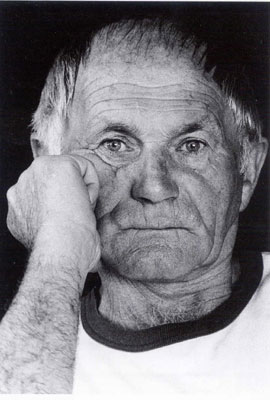
Now look at Hrabal's face.  It is a lovely human countenance--worn and wrinkled and a little sad.  The way a face might look if, for example, one has lived.
 
Too Loud: an idiot savant, or perhaps just an idiot, fond of beer, has spent thirty-five years pulping old books, and saving a few of them, storing them in his tiny room, a wall with two ton's worth of books, a wall of philosophy and history and ideas, some of which, at random, Haňtá, the pulp press operator, has memorized.  And what does he do with the random ideas that have stuck in his head like the greasy remains of ruined books have stuck to his body?


For thirty-five years I've been compacting old paper, and in that time I've had so many beautiful books thrown into my cellar that if I had three barns they'd all be full. Just after the war the second one - was over, somebody dumped a basket of the most exquisitely made books in my hydraulic press, and when I'd calmed down enough to open one of them, what did I see but the stamp of the Royal Prussian Library, and when next day I found the whole cellar overflowing with more of the same - leather-bound volumes, their gilt edges and titles flooding the air with light - I raced upstairs to see two fellows standing there, and what I managed to squeeze out of them was that somewhere in the vicinity of Nové Straseci there was a barn with so many books in the straw it made your eyes pop out of your head. So I went to see the army librarian, and the two of us took off for Nové Straseci, and there in the fields we found not one but three barns chock full of the Royal Prussian Library, and once we'd done oohing and ahing, we had a good talk, as a result of which a column of military vehicles spent a week transporting the books to a wing of the Ministry of Foreign Affairs in Prague, where they were to wait until things had simmered down and they could be sent back to their place of origin. But somebody leaked the hiding place and the Royal Prussian Library was declared official booty, so the column of military vehicles started transporting all the leatherbound volumes with their gilt edges and titles over to the railroad station, where they were loaded on flat-cars in the rain, and since it poured the whole week, what I saw when the last load of books pulled up was a constant stream of gold water cum pitch and printer's ink flowing down from the train. Well, I just stood there, leaning aginst a lamppost, flabbergasted, and as the last car disappeared into the mist, I felt the rain in my face merging with tears, [...]


What else would he do but weave what he has read into the fabric--however odd and eccentric--of his life?  When he drinks, or makes love, or works, or thinks, he does so in a fog of ideas induced by the books he has saved from the pulper. Like anyone's mind, Haňtá's  is untidy, but at least he can hang his random thoughts on the contents of the books he has read and memorized--Lao Tzu, Nietzsche, Holderline, and Hegel.

 A friend of mine and I batted this idea back and forth: what happens if books become more real to us than life itself?  Should we be upset if we if live vicariously, through the pages of the books we have come to love?  I wonder sometimes why  living through books should be different from any other kind of living--we live through our work, or other people, or some creed or ideology.  Pure living--the thing itself--is hard to find.  So why not through these little blocks of paper that put us--miraculously--inside the mind of someone else?

There they are, lined up like memory itself on the shelves, each one preserving a part of our life, associated with the people we knew then, the things we were thinking, the person we once were.   

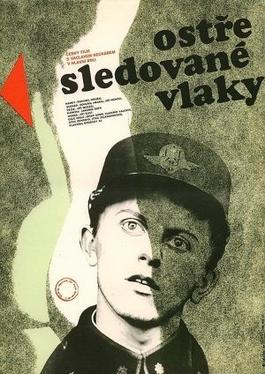
And who was this mysterious Czech writer?  Most readers know him through the adaption of his Closely Watched Trains, which won an Oscar for Best Foreign Film in 1967.  Hrabal was among the most popular Czech writers of the modern age.  Born in 1914, his books have been translated into twenty-seven languages; like many other Czech writers whose books have political content (e.g.  Milan Kundera), Hrabal was banned from publishing after the Prague Spring of 1968.  My favorite of his books is Dancing Lessons for the Advanced in Age, a novel in one sentence (I'll write about it here sometime).  But I loved the oddness of Too Loud a Solitude--it made me nostalgic for the great age of print, now, alas, passing from us.  Hrabal died from a fall from a fifth story window in the Bulovka Hospital in Prague in February, 1997 at age 82.

 File:Closelywatchedtrains.jpg

Too Loud a Solitude was translated by Michael Henry Heim and is published by Harcourt.

A good brief introduction to Hrabal is found here: http://art-bin.com/art/ahrabaleng.html

George Ovitt (2/25/13)