Monday, January 28, 2013

China Blues


Fortress Besieged by Qian Zhongshu  (圍城,围城


“1937 was a hellish year for China,” writes Jonathan Spence in his deeply informative introduction to this popular and highly acclaimed novel.  “After years of threats and corrosive expansion into Chinese territory, the Japanese finally moved to all-out war, first in the Peking region, and soon after in Shanghai…by the late fall of 1937, the Chinese troops had crumbled, and the Japanese advanced triumphantly through the largely abandoned defense lines to the Nationalist capital of Nanking.  There, in December 1937, the infamous ‘Rape of Nanking’ brought death or agonizing humiliation to hundreds of thousands of Chinese men, women, and children…. It is into this bleak setting that Qian Zhongshu unceremoniously tosses his hapless hero Fang Hung-chien.” 

Widely recognized as the greatest Chinese novel of the twentieth century, Fortress Besieged is, for all its satire of western-leaning intellectuals, scholars, philosophers, doctors, and professors, a remarkably un-political story, given the chaos and suffering in which it is set, focusing almost myopically as it does on the picaresque, often comical bumbling of the wisecracking “moral weakling”, Fang Hung-chien.  The prodigal son, Fang returns to China, to Shanghai, on the eve of the Sino-Japanese War, aboard the Vicomte de Bragelonne, a ship packed to overflowing with Chinese nationals, Indians, Vietnamese, French, and Jews in flight from Hitler.  With nothing but a fake diploma, no prospects for work, and the not unpleasant knowledge that his wealthy fiancée is dead, he sets out to find his place in the fraught and rapidly changing nation.  Yet the novel is hardly so serious as that, but asserts itself as a clever, unabashedly erudite comedy of manners in which we are introduced to a dazzling assortment of nationals and foreigners in late 1930’s China: “the lowly porters, shopkeepers, innkeepers, bus drivers, country folk, soldiers, prostitutes, and French policemen serving their mother country in her Concessions in China; the middle-class returned students, country squires, journalists; and the rising middle-class bankers, compradors, factory managers, Japanese collaborators, and others”, each delightfully, indelibly described.

Subtle, sophisticated, rife with allusions to Chinese and European philosophy, literature, history, culture, and folklore (each meticulously footnoted for those so inclined), Fortress Besieged is nevertheless a highly readable, highly satisfying novel for expert and novice alike.   

Qian Zongshu (Ch’ien Chung-shu, 1910-1998) is one of China’s foremost “scholar-novelists.”   A devotee of Hegel and Proust, and a master of classical Chinese, English, Greek, Latin, German, French, Spanish, and Italian, Qian is seen by many in China as the last link  in an unbroken chain of geniuses stretching back to Confucius.  Yet his life as a writer was anything but easy.  Having returned to China in 1938, like his character Fang Hung-chien, he, along with other intellectuals like him, was persecuted by Mao Zedong, forbidden to study and write and forced for years to work as a janitor. Besides being one of the few acknowledged masters of vernacular Chinese in the twentieth century, Qian was also one of the last authors to produce substantial works in classical Chinese, most notably his magnum opus, the five-volume Guan Zhui Bian, literally ‘the Pipe-Awl Collection,’ an extensive assortment of notes and short essays on poetics, semiotics, and literary history.

First published in China in 1947, Fortress Besieged was translated by Jeanne Kelly and Nathan K. Mao and published by New Direction Books in 2004. 

I’d like thank my friend Estelle Wu for her recommendation that I read Fortress Besieged.  I am grateful to her.

Peter Adam Nash

Sunday, January 27, 2013

Ko Un: Poet, Monk, Dissident


Ko Un's life story is remarkable.  He grew up in a poor, rural region of South Korea.  He has been imprisoned four times for his political views, in particular for his opposition to the military government of Park Chun-hee in the 1970's.  Ko also spent ten years as Buddhist monk (1953-63); he has written over one hundred books--of poetry, fiction, and memoir, of which only a fraction are available in English.  His name often comes up in discussions of the Nobel Prize, and yet few in the West are familiar with his work.  I was fortunate enough  to come upon Clare You's translation of Ko's selected poems, The Three Way Tavern, published by the University of California.  It's a lovely book, with a generous overview of Ko's work and a fine introduction to his life and aesthetic by Clare You.  Here is You's comment on Ko's character (a man after my own heart): "A man of wantonness and spiritual yearning, with outbursts of creative energy, and irrepressible distaste for oppressors, and insatiable appetite for the unknown, a wry sense of humor--this seems to describe the temperament of Ko Un."

 Ever since reading Kenneth Rexroth's versions of Tu Fu while in college, I have sought out a certain kind of East Asian writer--one who is able to turn deceptively simple observations of the physical world into  insights that uncover subtleties of human experience (of course, it isn't only East Asian writers who do this). Since I have no Asian languages, I rely on gifted translators to allow me, at most, an intimation of the world of these great poets--who can say what Tu Fu's intentions were when he wrote: "Screech owls moan in the yellowing/Mulberry trees. Field mice scurry,/Preparing their holes for the winter./Midnight, we cross an old battlefield,/The moonlight shines cold on white bones."  Reading this poem for the first time in 1968, I had no doubt of what Tu Fu was referring to--the "white bones" made his subject clear.  And yet I now understand that when we read poetry in translation, we are placing our trust in another writer in just the way, as children, we trusted our friends to catch us as we played "buck-buck."  In his wonderful book on Rilke, William Gass demonstrates in memorable fashion the problems of translating a poet whose world is rather familiar to us--but what of the lost worlds of Tu Fu or Ko Un?

With Ko Un the problem appears insurmountable: what do I know of Korea?  What did it feel like to grow up poor in Gunsan in the 1930's?  To attempt suicide over the depredations of the Korean War? To live as a monk?  All of this is beyond me, and what is left are the shards of a life, memorably preserved in simple verses.

Morning Rooster

At the rooster's second crow, she is thinking more
about her son who left home two years ago
than about her husband who died last year.
Because he's buried
on the hill out back, he didn't leave home forever.
When the rooster crowed at dawn,
Changok was gone, pounding a nail
into his mother's heart.
Hoping against hope he'd return at daybreak,
Mother was up, didn't even have a sip of cold water, just thought of him.
She folded the blankets on the chilly floor of her room,
swept the garden,
swept the first snow fallen outside the gate,
and straightened her back on the thought of her son.

The University of California Press maintains and regularly expands an exceptional poetry list.
http://www.ucpress.edu/subject.php?sc=poemaj

George Ovitt (1/27)

Friday, January 25, 2013

Climbing Mount Mordant/Thomas Bernhard


In German, Bissigkeit, with bissig being viciousness. Mordant.  Mordancy.  As in "The most mordant of writers was Thomas Bernhard."  No cynic, Bernhard could turn a huckster like Sartre to pâté en terrine with a single ten-page sentence.  The rollicking, circling, repetitive, nihilistic, unpackable, Kafkaesque cadences of Bernhard--the only writer apart from Kafka who makes me laugh out loud*--usually end at the same point, the very one Sophocles makes in Oedipus at Colonus (line 1225): "Better never to have been born."  The climax of Bernhard's Yes is an affirmation of suicide, and only the puckish Bernhard, who I would guess loved life in the way all true nihilists do, would write a mad monologue affirming that there is nothing worth affirming, that life is not so much absurd as horrifying, that no human act could have value, and that, nonetheless, the whole  affair is best understood not as tragedy but as farce. 

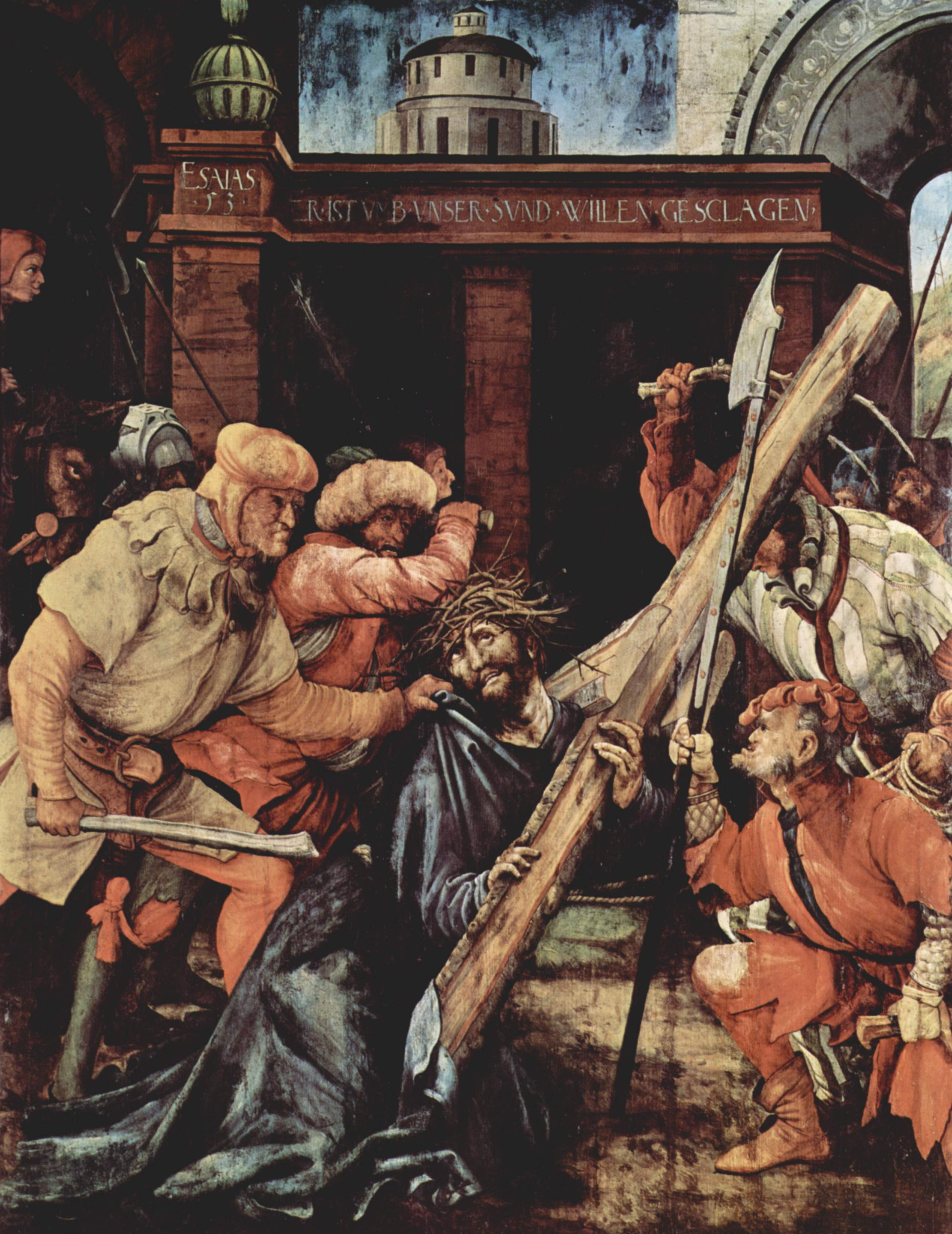
It would be coy to say that Bernhard was the great chronicler of our era; he wasn't, and such a notion  would have left him in stitches.  He was of no era, or perhaps he was of the greatest of centuries, the sixteenth, when wit and murder danced an allemande with plague and famine.  Moving through a typical blasted Bernhard landscape is like being parachuted into the milieu of Matthias Grünewald, perhaps into one of the panels of his Crucifixion, a world in which cruelty was seasoned with decorum--no anonymous drones dropping bombs in Grünewald; the lashes were applied by a man, whose grotesque mask seems to say--"Well, what can I do?"  As in Bernhard, the Old Masters were never mistaken about the causes and nature of suffering, and Icarus lands with an indifferent splash.


File:Mathis Gothart Grünewald 060.jpg

How radical a writer was Bernhard? Here is the publisher's description of his novel Gargoyles (a charming Christmas tale for the kids): "One morning a doctor and his son set out on daily rounds through the grim, mountainous Austrian countryside. They observe the colorful characters they encounter--from an innkeeper whose wife has been murdered to a crippled musical prodigy kept in a cage . . . " There's more. A "paranoid prince" and a "parade of human grotesques." No bestseller here. One imagines literary agents rushing to sign Bernhard to a mega-deal; motion pictures, a fawning review in Harper's, a Twittered version of the book for the attention-deficient crowd. Then again, perhaps not. On the surface, Bernhard is never a cheerful read, yet, as in The Castle, with its own version of the human nightmare, Bernhard's monsters are so clearly us that we laugh to feel reassured: yes, it really is all right to be vain, monomaniacal, greedy, and cruel. Bernhard's truths are often too much to bear, but they are truths nonetheless.

Reading Bernhard's Wittgenstein's Nephew or, my personal favorite, The Old Masters, one asks, 'what is comedy?'  Thanks to Shakespeare and Northrop Frye, we presume that comedies always veer toward weddings and renewals of life--as with the crocuses at the conclusion of Humbolt's Gift.  But also thanks to Shakespeare, we know there is more to comedy than transvestism, drunkenness, sexual double entendres, and nuptials. Shakespeare, after all, not only wrote "A Midsummer Night's Dream," but also "Measure for Measure," and "A Winter's Tale."  Aristotle taught us that tragedy purges pity and fear, but he also taught us that that comedy purges bitterness (ψόγος) and our  natural loathing of the absurd. One might argue that life is far more likely to provoke invective than a sense of fatedness--this is the central discovery of Kafka--a king knows tragedy, but we clerks feel absurdity in our bones.  The writer who thought "writing was praying," wrote these witty lines:

Last night I dreamt about you. What happened in detail I can hardly remember, all I know is that we kept merging into one another. I was you, you were me. Finally somehow you caught fire.”  

Somehow you caught fire. I have to laugh when I read this passage though there is nothing funny in it. Here is, I am certain, the meaning of Kafka's famous line about "the frozen sea within us."  Great literature wakes us up, and the more deeply we are asleep, the greater the tug needed to rouse us.

Bernhard travels a similar road, less fastidiously than Kafka:

"The atmosphere in Hoeller's house was still heavy, most of all with the circumstances of Roithamer's suicide, and seemed from the moment of my arrival favorable to my plan of working on Roithamer's papers there, specifically in Hoeller's garret, sifting and sorting Rooithamer's papers and even, as I suddenly decided, simultaneously writing my own account of my work on these papers, as I have here begun to do, aided by having been able to move straight into Hoeller's garret without any reservations on Hoeller's part, even though the house had other suitable accommodations, I deliberately moved into that four-by-five-meter garret Roithamer was always so fond of, which was so ideal, especially in his last years, for his purposes, where I could stay as long as I liked, it was all the same to hoeller, in this house built by the headstrong Hoeller in Defiance of every rule of reason and architecture right here in the Aurach gorge, in the garret which Hoeller had designed and built as if for Roithamer's purposes, where, Roithamer, after sixteen years in England with me, had spent the final years of his life almost continuously, and even prior to that he had found it convenient to spend at least his nights in the garret, especially while he was building the Cone for his sister in the Kobernausser forest, all the time the Cone was under construction he no long slept at home ....."  

This sentence continues, in the least compromising of all Bernhard's novels--Correction--and reprises all of the (three) numbingly and, eventually, hysterically repeated themes of the novel--the garret, the Cone, and the papers of Roithamer, another of the many stand-ins for Wittgenstein who often appears, thinly disguised, in Bernhard's novels.  How attractive the Wittgenstein's must have been to Bernhard--a family decimated by suicides!  One wonders what the austere logician of the Tractatus would have made of  Correction's baroque syntax and its relentless mockery of seriousness and taciturnity.  I've just quoted a passage from pages one and two; weeks later (it seems) we arrive on page one hundred twenty five and find this: "If I walk barefoot they won't hear me, I'd thought, and so as soon as I'd entered Hoeller's garret I walked around and back and forth a lot in my bare feet in order to practice this barefoot walking in Hoeller's garret..." One feels as if one is trotting up the down staircase, or trapped in a dream of jogging endlessly for a bus, not moving one inch. Or one is living one's life, as it is, and not moving one inch.

 "The limits of my language are the limits of my world," wrote Wittgenstein, and Bernhard appears to counter with the proposition "Even within the limits of language there is to be found an unlimited world."  This is what Bernhard shares with Kafka--the conviction that language need not take us anywhere--through neither narrative nor conclusion--to show the meaning of the world.  Why do we need beginnings, middles, and endings when, as in Kabala, every word is capable of pushing us into the abyss?


*See David Foster Wallace, "Some Remarks on Kafka's Funniness from Which Probably Not Enough Has Been Removed," in Consider the Lobster. Typical Wallace: "It's not that students don't 'get' Kafka's humor but that we've taught them to see humor as something you get--the same way we've taught them that a self is something you just have. No wonder they cannot appreciate the really central Kafka joke: that the horrific struggle to establish a human self results in a self whose humanity is inseperable from the horrific struggle."  It is much the same with Bernhard, with outcomes more likely to result in despair than resignation. 

Perhaps as a bit of publishing pro bono work, one finds Thomas Bernhard's books in so-so Vintage Paperback editions, with outdated prefaces (by, for example, George Steiner--two pages!).  But this is being rectified, as in the new edition of Gargoyles, which has no introduction whatsoever. 

Bernhard, the wittiest of misanthropes, whose account of his literary prizes (My Prizes: An Accounting)  is the last word in the genre of Self-Justifiying Public Ingratitude, isn't for the faint of heart.  But you never know: look at how popular David Lynch was for a few seconds.  The Bernhard lover hopes a serious press will take up the cause--and quickly--of reissuing TB in suitable editions so that one can disseminate mordancy at the appropriate holidays.  


George Ovitt (1/25)


Thursday, January 24, 2013

The Other Europe


Contemporary East European Poetry: An Anthology, edited by Emery George

How many Eastern European poets can you name? Until some months ago I myself could name but three: the Polish and widely-feted Milosz, Szymborska, and Zagajewski. Great poets, surely but hardly representative when it comes to the dazzling multitude of nations, languages, and cultures that comprise this historically rich, politically charged region, a fact made plain to me one evening when I happened upon a copy of this extraordinary anthology in a local bookstore. “Eastern Europe is one half of Europe,” writes the editor, Emery George, in his introduction to the collection. “It is a vast and vital realm of society and culture which, for all the attention lavished on it since World War II, remains for many Americans either that sinister expanse ‘behind the Iron Curtain’ or, at best, ‘the old country,’ where tales of Dracula, ethnic grandmothers, and good recipes come from.” 

Offering readers a sampling of the work of no less than 162 contemporary poets, both men and women, from at least fifteen different languages, this volume is astonishing both in its breadth and resonance, stamping the names and homelands of these poets on the cluttered, workaday maps in our brains. Including writers from Estonia, Latvia, Lithuania,Poland, Croatia, Macedonia, Serbia, Slovenia, Bulgaria, Hungary, Romania, as well as former Yugoslavia, Czechoslovakia, and East Germany, editor Emery George also provides a short if illuminating section on Yiddish poets still writing today. Here, from the anthology, is my own brief sampling:

In Chalk Rooms

                                                                 let all the walls
                                                                 about me be green
                                                                 like a whole harvest
                                                                 of summer’s meadows
walls like light
        sliding through green bottle-glass
walls like forest
       moss-grown and damp
walls like mouldy
       cheese on a knife
and walls like frogs
       so cool and loud
walls with gentleness
        like budding leaves
walls of juiciness
        as of chopped turnip tops
walls in that tone
        in which rain soaks moss
and yellowed like cabbage
        butterflies abandoning cocoon
walls hard and green
        corrugated wet
encompassing me
                                                                 as have only woods and waters.
                                                                 but the world listens
                                                                 to me as to a gnat’s song
                                                                 though I suffer terrible
                                                                 famine for greenness

 Aina Kraujiete (Translated by Inara Cedrins)


Father’s Winter

The birds have all left
my father’s tall trees.
Now only frozen stars
cling to the black branches.

Old farm tools stand stagnant:
plows, scythes, hands and hoes.
It seems there is nowhere to go,
nothing to make us wonder.
The wonders of Father’s life
have passed unnoted and expected—
who will marvel at the water or grass,
or write down the spring or winter?

If you listen, at night
you can hear the deep and heavy sighs
of the senile, faithful Guernsey 
passing up from the cattle-shed.

All thoughts, like snow, blend to one.


Justinas Marcinkevičious (Translated by  Irene Pogožzelskyte Suboczewski)


The Early Chaplin

We know the early Chaplin but before him
was an earlier Chaplin   Those films
are already forgotten   Chaplin
had the face of a brute he bared his teeth
like a wildcat readying to spring and had no
scruples he seduced women hired gangsters
to rub out his rivals rejected he sought revenge
by all means fair and foul when the lovely Mabel
Normand was in an auto race this blackguard
wetted down the pavement switched around the signs sending
the car to the precipice planted dynamite despite
everything Mabel survived and won he almost
burst with fury the audience
was bursting with laughter and of course showed
him no sympathy at all   He did not yet have
his dress suit cane mustache   He had
a monocle and goatee   His name was not
Charlie but Chas   This went on
for some time  But in time
his face figure and inner self began to change  This
happens not only to actors but
to apostles and mere mortals   More than one
person has lived through this in his youth wondering
and suffering when his skin
hardened in a grimace which
seemed to be an exact replica
of the inner self when it crumbled and again froze
in another mould    No one knows
how all this happens   This is no
run-of-the mill decision  Maybe inspiration   Thus Chaplin
after making thirty-five films went ahead and
changed from Chas to Charlie   In the last
of these films they both were there Charlie
dreamed of being Chas   From sleep
the loiterer was wakened by the policeman’s stick   He got up
from the park bench and hobbled
into the distance with an embarrassed smile   There was no
anger in him only hope   No craving
for success but a desire
to defend human dignity   From the pursuer
he became the pursued   And this was now
the early Chaplin whom
we came to love without ceasing to laugh

Wiktor Worosylski (Translated by Magnus J. Kryńnski and Robert A. Maguire)


Emory George is the author of sixteen books, including seven of his own poetry and two collections of the work of Hungarian poet Miklós Radnóti.  Contemporary East European Poetry: An Anthology is published by Oxford University Press.

Peter Adam Nash 

Tuesday, January 22, 2013

Zero Hour

Stephen Dunn is one of a half-dozen living poets to whom I turn regularly--for delight in his metaphysical wit, for insights into what poetry can do to ease our overheated lives, for the pleasure that comes with watching someone find just the right word.  This is a favorite, and speaks to a question never far from my mind--


Zero Hour

It was the hour of simply nothing,
not a single desire in my western heart,
and no ancient system
of breathing and postures,
no big idea justifying what I felt.

There was even an absence of despair.

"Anything goes," I said to myself.
All the clocks were high. Above them,
hundreds of stars flickering if, if, if.
Everywhere in the universe, it seemed,
some next best thing was gathering itself.

I wanted to feel something,
but it was nothing more than a moment
passing into another, or was it even less
eloquent than that, purely muscular,
some meaningless twitch?

I'd let someone else make it rhyme.


Dunn, born in 1939, is the author of sixteen books and teaches at Richard Stockton State College in New Jersey.  This poem is from Different Hours, published in 2000.

Monday, January 21, 2013

Alberto Moravia: Two Friends, three versions

Alberto Moravia

I like the writer as an older man, as here; the great Alberto Moravia, a writer who, above any other, evokes for me the urbane (and lost) life, as in La Dolce Vita, Marcello Mastroianni, Sophia Loren, and the trinity of twentieth century emotions--boredom, contempt, and amour (always problematic, often failed).  Moravia's novels and stories, especially The Conformist (1947), Conjugal Love (1947), Contempt (1954), and Boredom (or The Empty Canvas 1960) are replete with the world-weariness and anxieties of a European post-war generation that lamented what was irrevocably lost--a generation that echoed the fin-de siecle sensibility of Joseph Roth, Stephan Zweig, and Robert Musil. In Moravia, the failure of love is the failure of larger hopes and a mirror for the duplicities of political and social life generally.

The three novellas collected in Two Friends, translated by Marina Harss, and beautifully produced by Other Press in a volume that also contains a splendid introduction by Thomas E. Peterson, variant textual readings of the novellas, and an account of the discovery of the typescript of the book in a suitcase in the basement of Moravia's home on Lungotevere della Vittoria, reprise Moravia's central themes: political turmoil, sexual longing, domestic betrayals, and bad consciences.  For the admirer of Moravia, the great attraction of Two Friends is the opportunity to observe the writer's process of composition.  Each of the three versions of the text contains essentially the same story--that of the troubled relationship between the wealthy playboy Maurizio and  the idealistic/apathetic intellectual  Sergio--but in each version Moravia shifted focus and narrative voice, struggling, it appears, to find the best way to tell the story. 

In Version A, set in 1938, Maurizio and Sergio cope, each in his own way, with fascism and the war--Maurizio through womanizing and self-pity, Sergio through a kind of half-hearted anti-fascist engagement.  In Version B, set in 1945, Sergio has joined the Communist Party, though not so much from conviction as from boredom; he is in love with Lalla, and, as he often does, Moravia demonstrates the ways in which a sexual relationship fails to compensate for a dearth of human feeling--in this case, Sergio's.  Version C, narrated in first person by Sergio, is the most satisfying and fully realized of the three retellings of the story, with Sergio and Maurizio now plausible rivals in love and politics, and with a fuller development of Lalla's (now Nella) character. 

Moravia's view of women can be odd--they at times appear to be nothing more than sexual vessels, or objects of male "ego-projection" (Moravia--the consummate Freudian novelist!), but, when he needed to do so, when the story required it,  Moravia created women who were more fully realized characters than their often self-absorbed male counterparts.  In my view, Moravia's strength lies in the ideas he puts at the center of his stories, those "what if" thought experiments that depend as much on mood and language and tone of voice as on plot or character.

Moravia is among the most cinematic of writers--that is perhaps why Bertolucci, Godard, de Sica, and others have made (quite good) films of his books. He crafts mise-en-scène like a screenwriter, then evokes character with precise exchanges of dialogue and minimal authorial interference. 

Here is a bit of description, clear-eyed and rendered without nostalgia, taken from Version A. Sergio is seeing Maurizio's home and garden after many years away:

In [Sergio's] memory, the garden was large and full of trees; now it appeared to be a small rectangle with a few medium-sized trees and two or three flower beds surrounded by gravel paths. But the gravel was dirty and the flower beds had been invaded by weeds which had begun to turn yellow in the summer sun. The trees had grown wild, but no taller. He noticed an air of neglect and age, which he could not pinpoint in any single element but seemed to affect everything. Just as old age exacerbates certain characteristics, this air of neglect was neither poetic nor atmospheric; it was not the melancholy, charming neglect of an aging castle, but rather the casual indifference that clings to something that is neither beautiful or ornate.

Moravia's novels are available both from Other Press and New York Review Books.  Here are the links:

http://www.otherpress.com/books  and  http://www.nybooks.com/books/ 

George Ovitt (1/21; Martin Luther King, Jr.'s Day)

Sunday, January 20, 2013

Flâneur


"The crowd is his element, as the air is that of birds and water of fishes. His passion and his profession are to become one flesh with the crowd. For the perfect flâneur, for the passionate spectator, it is an immense joy to set up house in the heart of the multitude, amid the ebb and flow of movement, in the midst of the fugitive and the infinite. To be away from home and yet to feel oneself everywhere at home."
                                             Charles Baudelaire

“Man as civilized being, as intellectual nomad, is again wholly microcosmic, wholly homeless, as free intellectually as hunter and herdsman were free sensually.”  
                                             Oswald Spengler


Flâneur. Derived from the French verb flâner, meaning “to saunter or lounge”, flâneur is a term traditionally understood to mean "stroller, idler, walker". As described on The Arcades Project website, he is typically an educated man and wealthy enough to spend his days strolling idly through the streets of Paris (or some other such city), probing his surroundings and making observations about people and places that might otherwise go unnoticed. He is “a narrator who is fluent in the hieroglyphic vocabulary of visual culture,” a voyeur with a “cool but curious eye”. Rootless, anonymous, an inveterate outsider, he is a man who, for all his refinement, for all his vanity, is wildly protean in nature, sometimes invisible, often solipsistic, degenerate, effete. He is a parasite, “dragging the crowd for intellectual food.” And how we envy him this, this indulgence of eye and heart and mind. From Charles Baudelaire, Georg Simmel, Marcel Proust, and James Joyce to Franz Hessel, Walter Benjamin, Juan Goytisolo, and Edmund White, intellectuals and writers alike have found themselves transfixed by the enigma of this distinctly modern, distinctly urban prowler.


The nameless 46 year-old narrator of Genazino’s short novel The Shoe Tester of Frankfurt is just such a man.  While not wealthy enough to support his penchant for wandering the streets of Frankfurt, he is lucky enough to be employed by the small but rapidly expanding Weisshuhn Shoe Factory as a tester of shoes! And so begins the irony, the humor, of this lightly, delightfully philosophical tale. “All you have to do is spend the whole day walking around in brand new shoes,” explains the narrator, “and then write as detailed a report as possible about your sensations while walking.” Troubled by his past, by failed relationships, by love, he lives his days in silent rebellion against what he calls his “unauthorized life”--the fact that he was born into the world without his consent. Yet he is no misanthrope--no Timon of Athens, no Schopenhauer.  As with all flâneurs he finds the city irresistible, drawn out of his apartment each day to wander its crowded streets, to examine its shops and restaurants, marveling like a child at the sights and sounds, and piecing them together as clues. For the details of urban life, he has a promiscuous eye (and nose), noting with interest, with pleasure, a woman in a wheelchair, a Mickey Mouse tie, the stench of “hairspray, gasoline, bratwurst, smoke and chicken excrement.” He marvels at a cockeyed dog.  In his ramblings through the city he notices a Japanese woman eating a peach, admires “an old cardboard trunk with a tin-plated handle”, observes an elderly gentleman in a restaurant who has dropped a potato on the floor. The “unlooked-at-people” hold a particular fascination for this man without qualities in his restless struggle to make sense of the city in which he swims, to discover the meaning of his aimless, lonely, fish-like life.


Wilhelm Genazino was born in Mannheim, Germany in 1943, has published numerous books, including eight novels, a trilogy, and two collections of essays.  His many literary honors include the Bremer Literaturpreis (1989), the Hans-Fallada-Preis (2003), and the Georg-Büchner-Preis (2004).  He lives in Frankfurt.  The Shoe Tester of Frankfurt was translated from the German by Philip Boehm and published in 2006 by New Directions Books, New York. 

Peter Adam Nash

Saturday, January 19, 2013

Czeslaw Milosz: 'Meaning'

Hearing Czeslaw Milosz read, with Robert Hass, at the Library of Congress, in early January, 1993--almost twenty years ago to the day--was one of the better experiences of my literary life.  An old man, with wild eyebrows, reading in Polish and English, on a night that was bitter cold (as my journal reports) but full of stars....Milosz was kind enough to shake my hand and ask if the reading had pleased me.....

Meaning

--When I die, I will see the lining of the world.
The other side, beyond bird, mountain, sunset.                                 
The true meaning, ready to be decoded.
What never added up will add up,                                        
What was incomprehensible will be comprehended.

--And if there is no lining to the world?
If a thrush on a branch is not a sign,
But just a thrush on the branch?  If night and day
Make no sense following each other?
And on this earth there is nothing except this earth?

--Even if that is so, there will remain
A word wakened by lips that perish,
A tireless messenger who runs and runs
Through interstellar fields, through the revolving galaxies,
And calls out, protests, screams.


From Provinces, Poems 1987-1991 published by Ecco Press in 1991; translations by Milosz and Robert Hass

George Ovitt (1/19)

Friday, January 18, 2013

Zeroville, a Steve Erickson production


1. First of all, let's hope you know that this is a picture of Montgomery Clift and Elizabeth Taylor and not a picture of James Dean and Natalie Wood.  You knew that, right?

2. The movie is "A Place in the Sun," directed by George Stevens and released in 1951.  It is a very good movie.

3.  This photograph is not a still taken on the set of "Rebel Without a Cause," directed by Nicholas Ray and released in 1955--a very mediocre movie, despite Sal Mineo.

4.  Is this clear? 

5.  On a simple level, Zeroville is a novel about the difference between these two movies.  It is also a novel about what it means to love movies more than life itself.  It is also about Hollywood corruption, but this isn't news and not therefore a particularly interesting part of the book.

6Zeroville is written in numbered "cuts," that is, in short bits of prose, spliced together.  Each splice forms a small part of the narrative; the effect is jumpy, unfinished, cinematic.  Almost exactly like the kiss to your right that is about to happen. (Yes, of course: they were the two most beautiful human beings ever to act in movies.  Monty the only man who could compete with Liz for looks and that something else).  If I were to say, "Cat on a Hot Tin Roof," you wouldn't be thinking Scarlett Johansson, would you? 

7.  Every reader of a certain age (who is honest) will admit to having been mesmerized by Susan Sontag's book Against Interpretation (1966).  I admit it.  In this book of essays Sontag made a plea for movies--for film or cinema (with a French intonation)--as a serious art form.  She wrote seemingly brilliant essays on directors like  Francois Trauffaut and Jean-Luc Godard--the auteurs of la nouvelle vague cinema--post-war French films, of which the touchstones were films like The Four Hundred Blows and especially Godard's Breathless. In the late, great Village Voice, Andrew Sarris wrote essays in the style of Cahiers du cinema analyzing--taking seriously as art--American films by directors like Orson Welles, John Ford, and Nicholas Ray.  Reading Sontag and Sarris, I gave up Latin and began to study French so I wouldn't be distracted by subtitles.  To be young was very heaven. 

8. One became a cineaste under the spell of Sontag and Sarris, Trauffaut and Godard, Fellini and Visconti, Ford and Ray and Stevens.  My favorite film became Jules et Jim (still is), and "screenings" in art houses thick with cigarette smoke (Gitanes, if you could get them, Players Navy Cut if not) and cheap wine were the preferred weekend pastime of a certain sort of person. 

9. Erickson evokes this world through his slightly mad, cineautistic anti-hero Vikar--not Vicar--a naive, monastic, violent, obsessed fan of movies.  "Fan" might be too mild.  Vikar lives movies; they define his thoughts, his view of the world, his language, his cultural yearnings, his relationships (such as they are: that's the problem with movies, they aren't real).  He also happens to be an idiot savant film editor, the creator of enigmatic masterpieces, a man who is flown to Madrid to cut a film, to New York to save one--no one understands his work, which makes it valuable. Vikar is "pure of heart."  The quotation marks are, I think, required; Erickson's writing is so marinated in irony that it's difficult to believe anything--not for its being unbelievable, but for its being so displaced from ordinary experience.  If Erickson were a director, he'd be Fellini with a tablespoon of Tarantino.

10.  Have I mentioned that Vikar has a tattoo of MC and ET on his head--that's on his head--pictured in the climactic embrace of "A Place in the Sun"?  And he gets very upset if someone says to him, "Nice tattoo of Natalie Wood."  But you can see his point. 

11.  Vikar grows on you.  He looks out for people, especially the abused young (nine? eleven? thirteen?) daughter of Soledad, who is herself probably not the illegitimate offspring of Louis Buñuel, the great Aragonese filmmaker, whose mother (in real life) paid for the unforgettable short film "Un chien Andalou," a film designed to prove, if nothing else, that someone could be weirder than John Waters (I walked out of Pink Flamingos but adored Viridiana).  All of this, like Erickson's novel, becomes very complicated, especially if you don't  have an encyclopedic knowledge of the movies. I don't, so I looked up a lot of stuff. 

12. Erickson is a fine writer.  His prose is simple and unadorned. "Vikar restrains the urge to pick up the small bell from the desk and lodge it in the philistine's forehead."  The philistine did not recognize Montgomery Clift.  Often Vikar's restraint fails him.

13.  For Vikar--I can't speak for Erickson--the enemy of movies is music.  I'm not sure why.

14.  Charles Manson makes a sort of cameo: you have to have cameo appearances in books about film.  There are other cameos and half-disguised real-life film figures: for example, Robert De Niro shows up at a beach house in Malibu, sometime before that Taxi Cab movie.

15.  I don't go to the movies any more.  But if I did, I would probably not have enjoyed Zeroville as much as I did (it's a big book, but a quick read, divided as it is into short spurts of prose).  That's because Erickson appears to despise modern Hollywood culture, and the culture of Hollywood.  Hard to blame him.

Steve Erickson, Zeroville, published in 2007 by Europa Editions (who publish some fine books).

George Ovitt (1/18)

Wednesday, January 16, 2013

Roberto Bolaño: Antwerp: "I am amazed to see myself here rather than there" (Pascal)

The continued publication and popular packaging of [Bolaño's] incomplete work may actually be diluting his reputation as a writer of varied talents and fearless ambition. Sam Carter, The New Republic

Unlike Mr. Carter, I am of the school of thought that says--the more Bolaño the better.  Even  when the great Chilean/Mexican/Spanish poet and novelist isn't at his best, his work is full of riches--powerful writing, dense plotting, and significant themes. In Bolaño there are always passages, sections, or in the major novels hundreds of pages of writing that are inspired and unlike anything else written in the last part of the twentieth century and the troubled first part of the twenty-first. The final two hundred pages of Savage Detectives, the long middle sections (three and four) of 2666, the tighter and fully satisfying By Night in Chile, and the more recent Monsieur Pain--flawed, and perhaps too derivative of his own work, but still a fine book, full of energy and great writing. 


Antwerp is a greeting card of a book--a dinghy attached to 2666 or to the new Woes of the True Policeman.   But Antwerp contains some of Bolaño's most lyrical writing. Written in 1980, a book "written for the ghosts," Antwerp was published in the year before  Bolaño's death, but it contains, in brief fragments, many of the main themes of his longer works--a mystery story, a melancholy narrator, cameos by the author, motorcycles and sleaze and corruption--the world, in other words, run amok, but ordered, always and only, in prose. "It's summer and the policemen are drinking at the back of the bar. Next to the jukebox a girl listens to the latest hits.  Around the same time, someone is walking, far from here, away from here, with no plans to come back."

As in any Bolaño novel, no matter what is taking place in the foreground, something bad is occurring just off stage--as in the numbingly brilliant 'Part About the Bodies' in 2666; as one reads, one knows that a woman is being killed, right now, somewhere in the Sonora, and the build up of tension, of despair, is visceral, unlike anything else I can think of in literature.  In addition to its thin but compelling story, Antwerp pays homage to Cortázar; the fifty-six short sections of the book, less than a page each, are interchangeable, the story not so much a narrative as a shifting of moods, an adumbration of ideas, scenes, characters, riffs.  Sophie Podolski is here, rapist cops pop up in the bushes, Englishmen who haven't a clue glide through a sentence, various unnamed girls who enjoy sex and sunsets, and  also many of the tropes of Romantic Dogs--Bolaño's 2006 collection of poems--and, above all, the same powerfully rendered feeling of the flimsiness of the world--of relationships, lives, hopes, youth--all of which, in Bolaño's view, are about to come to an end.  All that endures in Bolaño is writing. 

"Of what is lost, irretrievably lost, all I wish to recover is the daily availability of my writing, lines capable of grasping me by the hair and lifting me up when I'm at the end of my strength. . . Odes to the human and the divine.  Let my writing be like the verses by Leopardi that Daniel Biga recited on a Nordic bridge to gird himself with courage." 

Published by New Directions and beautifully translated by Natasha Wimmer, who has done so well by Bolaño.

George Ovitt (1/16)                                                    

France, 1949


                                                                                                                             as night
                                                                               follows day
                                                                                                                 
                                                                                                                                Pierre Moinot


Two men are found murdered in a little village in the Poitou region of western France, a baffling, inscrutable killing that infects the lives of its inhabitants who are suddenly forced to regard each other with suspicion and fear.  Set in the wake of WWII, in a region sacked and settled by marauding tribes since time immemorial (by the Celts, the Romans, the Vandals, the Visigoths, the Franks, the Vikings, and most recently the Nazis), this short novel is a powerful, often exceptionally tender depiction of the weight and trauma of the past.  Shifting between the perspectives of seven different villagers, male and female, young and old, the story that unfolds is distinguished by the author’s intimate knowledge of and abiding affection for these humble, rough-hewn folk—farmers, shepherds, and guildsmen—who, for all of their fatalism and poverty, are richly illuminated by their propensity, their capacity, to love.

In the opening section of the story an elderly woman named Maria, perhaps my favorite of the many characters, reflects upon a former lover of hers in a language and phrasing typical of Moinot: “Maybe the effect that he had on me, the stone, there, in my chest, maybe that was jealousy after all. But never a word. I would have gotten nothing but cajoling from him; he did not know how to hide what he tried to win forgiveness for.  And maybe I never, never forgave anything…” Moinot’s description of these people is never condescending, but he invests them with an intelligence—however unschooled—that is often blithesome, poetic: “Early in the morning, closing the little valley gate, Lortier gradually concealed behind one of the thick doors the image of his happiness: over there, in front of the house, Mo was folding a sheet with one of her girls and both of them were laughing because one of them had pulled too hard at the wrong time on the folded cloth, and the other had let it go; behind them a very old rosebush was studded with white blossoms, and the structure of the arbor bending into the flower and vegetable gardens marked off a verdant foreground.  At the center, the brilliant whiteness of the sheet contrasted dramatically with the golden stone of the old walls and seemed to reflect the sun into Mo’s gray hair so she appeared blond.  This timeless scene erased forever the wars, the murders, and the cruelties that the fortified house had withstood. Lortier gently closed the door again behind him, as though to protect it.”

While particularly adept at tracking the emotional lives of his characters, their fears and joys and failings, Moinot devotes a significant part of his power to describing the natural world around them—the plants and animals, the seasons and cycles to which these villagers are bound, quickening this otherwise dark and fallow tale with a lyricism that is often  sublime. The countryside of small farms and shallow valleys is alive with blackbirds and cuckoos, with calyxes and violets, with foxes and weasels and hares.  The characters themselves have a special affection for such georgic details, noting with pleasure, as they sit alone or cross a field or wood: “the vibrant trembling of the dragonflies”, “the little fox and badger trail”, “ “the perfect sphere of a leek flower gone to seed”. 

Described by Booklist as a “masterful literary thriller”, As Night Follows Day is nothing of the sort, that is, unless the thrill you seek is the thrill of language itself, in which case you will speak with wonder about this adroit and compassionate tale. 

Pierre Moinot, born in 1920, is the author of over a dozen novels as well as works for  the stage and television.  Friend of André Malraux and Albert Camus, Moinot was elected in 1982 to the prestigious Académie Française.  As Night Follows Day (Le matin vient et aussi la nuit, Editions Gallimard,1999) is published in New York by Welcome Rain Publishers.  http://www.welcomerain.com/


Peter Adam Nash

Tuesday, January 15, 2013

Maxine Kumin


Kumin is hardly an obscure poet--but then again: over the holidays an acquaintance of mine informed me that even a 'bestselling' book of poems reaches a minuscule audience, maybe a thousand copies of a Billy Collins or Mary Oliver book are sold; apparently there is a web site featuring a fellow firing different kinds of rifles--that's it, just shooting guns--that has had 500 million hits, which figure is at least one hundred times greater than the total sales of all books of poetry since the composition of Gilgamesh.  So: all poets are obscure. Well, so what?  I think they like it that way.  When I read Poetry magazine, I always think--who the hell reads this stuff?  And then when I read the reviews I know the answer--people working on MFA's in poetry read poetry, poets read poetry, and about two hundred and twenty six other folks, ordinary folks, are willing to shell out sixteen dollars for a slender volume of verse; indeed, they can imagine no better use for their money.  That's the world we live in--six hundred bucks to shoot off an AR-15 and $16.95 to spend a blissful afternoon with the great farmwoman poet, Maxine Kumin.  De gustibus.  

I'm one of the two twenty-six.  I just bought Maxine Kumin's Where I Live--three copies in fact--and I love this book so much that I'd like to make a You Tube video of myself reading it. Kumin has made a career of writing poems in the vernacular, in simple language that resembles nothing so much as a roller-coaster ride--full of metaphysical twists and turns, hair raising syntactic stunts, and an eye for the landscape below.  Here's one from the new book:

The Brown Mountain

What dies out of us and our creatures,
out of our fields and gardens,
comes slowly back to improve us:
the entire mat of nasturtiums
after frost has blackened them,
sunflower heads the birds
have picked clean, the still
sticky stalks of milkweed
torn from the pasture, coffee grounds,
eggshells, moldy potatoes,
the tough little trees that once
were crowded with brussels sprouts,
tomatoes cat-faced or bitten into
by inquisitive chipmunks,
gargantuan cucumbers gone soft
from repose. Not the corn stalks and shucks,
not windfall apples. These
are sanctified by the horses.
The lettuces are revised
as rabbit pellets, holy with nitrogen.
Whatever fodder is offered the sheep
comes back to us as raisins
of useful dung.
Compose is our future.
The turgid brown mountain
teams, releasing
the devil's own methane vapor,
cooking our castoffs so that from
our spatterings and embarrassments--
cat vomit, macerated mice,
rotten squash, burst berries,
a mare's placenta, failed melons,
dog hair, hoof parings--arises
a rapture of blackest humus.
Dirt to top-dress, dig in. Dirt fit
for the gardens of commoner and king.

Kumin redeems the list-filled poem with touches that show the depth of ordinary things: "repose," "sanctified," and "rapture" are perfect; and the line, "Compost is our future"--how simple and ironic....yes, it is our future.  Kumin is funny ("The Nuns of Childhood: Two Views" or "Coleridge's Laundry"); ecstatic: "I tear the caul, look into eyes/as innocent, as skittery/as minnows." ("Praise Be"), and, best of all, poetic, as in making me see something in my world, something ordinary or liable to be overlooked, in a wholly fresh way: the zen of poetry is in the seeing, the wrapping of something in beautiful language, the opening of the reader's eyes.  I am often too dull for my own good, but poets like Kumin make me  better than I would otherwise be--this one, for me, tips the scales, and it is the one I plan to memorize:

Sonnet In So Many Words

The time comes when it can't be said,
thinks Richard Dalloway, pocketing his
sixpence of change, and off he goes
holding a great bunch of white and red

roses against his chest, thinking himself
a man both blessed and doomed in wedlock
and Clarissa meanwhile thinking as he walks back
even between husband and wife a gulf . . .

If these are Virginia and Leonard, are they not
also you and me taking up the coffee
grinder or scraping bits of omelet free
for the waiting dogs who salivate and sit?

Never to say what one feels.  And yet
this is a love poem. Can you taste it?


Can you taste it?  I can.

George Ovitt (1/15)

Where I Live: New and Selected Poems, 1990-2010, is published by W.W. Norton