Tuesday, December 13, 2016

The Open Mind of Lafcadio Hearn


Lafcadio Hearn: Writings From Japan, edited by Francis King

The year my girlfriend (now wife), Annie, asked me to spend the summer travelling around Japan with her, I didn’t know what to expect. Of course I’d eaten sushi, teriyaki, and tempura, and had seen a couple of Kurasawa films—if with the bright unknowing of a pilgrim at Plymouth Rock. I was as ignorant of the country as I was happy and eager to see it.

Annie, a former East Asian Studies minor in college, did her best, in the months preceding our trip, to prepare me for the adventure to come, lending me books about Buddhism and Shintoism, pressing me to read the various travels guides she’d collected, and speaking with wonder about her own first trip there the previous summer to visit a close college friend. Just before we left for Japan Annie’s stepfather, the late sociologist Robert Nisbet, gave me a book, Hearn’s Writings From Japan, a number of the essays of which he had read and liked very much when he was stationed on Saipan during World War II. I thanked him kindly for the gift and packed it away.
 
It wasn’t until we’d already been in Japan for some weeks, settled for a spell, after our first stint of travelling, in a handsome old house in the town of Hayama, overlooking the long, wide curve of Sagami Bay, that I actually opened the book and read. What I discovered in those pages not only transformed the country I saw before me each day, but kindled in me an affection for Japan—for the dreamlike strangeness of the land, its people, and its past—that haunts me to this day.

My initial hours in the country were a glorious, intoxicated blur, an experience perhaps best captured by Hearn himself when he first set foot in the country, in nearby Yokohama, nearly a hundred years before me, in the spring of 1890:

It is with the delicious surprise of the first journey through Japanese streets—unable to make one’s kurama-runner understand anything but gestures, frantic gestures to roll on anywhere, everywhere, since all is unspeakably pleasurable and new… ‘Tis at first a delightfully odd confusion only, as you look down one of them [the streets], through an interminable flutter of flags and swaying of dark blue drapery, all made beautiful and mysterious with Japanese or Chinese lettering. For there are no immediately discernable laws of construction or decoration: each building seems to have a fantastic prettiness of its own; nothing is exactly like anything else, and all is bewilderingly novel. 


By the time of Hearn’s arrival, Japan had been visited and written about at length by writers as esteemed and varied as Pierre Loti and Rudyard Kipling. Following the invasion of Commodore Perry and his fleet of American warships in 1853, the modest, introverted, once-insular Japan had been overrun by westerners, by “diplomats, advisers, teachers, businessmen and journalists”, each armed with something new to teach the Japanese, something by which to draw them out (meaning westward) into the bright and ‘civilized’ world.

Lafcadio Hearn was different, precisely in that regard, encountering all he saw before him in the country with a child’s wonder, with a mute and goggling awe. Yet in his thinking he was hardly simplistic, naïve. Indeed his critical acumen in these essays (his extraordinary ability to see) is unmistakable, buoyed—though it nearly always is—by his enchantment, his humility, his glee. 
 
What followed for me, that long, chimerical summer in Japan, were weeks of reading and rereading the essays in this collection, and of wandering the nearby towns and villages with my intrepid guide and girlfriend, Annie. Together we’d delighted in the shops and temples, and in the local festivals (Tanabata and Obon), while admiring the gardens and graveyards and shrines—and all through Hearn’s deeply observant, deeply affectionate eyes.

Surely a part of the charm of Hearn’s work for me that summer was the house in which we happened to be staying, a traditional Japanese house on a narrow street above the bay, complete with a genkan, tatami, shoji, and a tokonama, as well as a free standing teahouse from which we’d had an unbroken view of Mt. Fuji (This photo could have been taken from our backyard!). 


We could hardly believe our good fortune, our luck. Tired, our resources already strained by the cost of living in ryokans and hostels, we’d all but stumbled  into taking care of the house for a retired U.S. Navy nurse, then on emergency medical leave in the States, a distinctly Hearn-like woman who, since her arrival in Japan at the end of WWII, had come to love the country so much that she’d made it her home. Not surprisingly, the house was filled with Japanese antiques—porcelain, screens, various tansu or chests, woodblock prints, and a fantastical array of Buddhist statues. If that were not enough to set the scene for that magical summer of ours, we’d received a letter one day, from the owner herself, thanking us again for taking care of her house and encouraging us to have a look at her collection of netsuke in the shoeboxes beneath the guestroom beds. Netsuke? we wondered. What in the world were netsuke? 
 
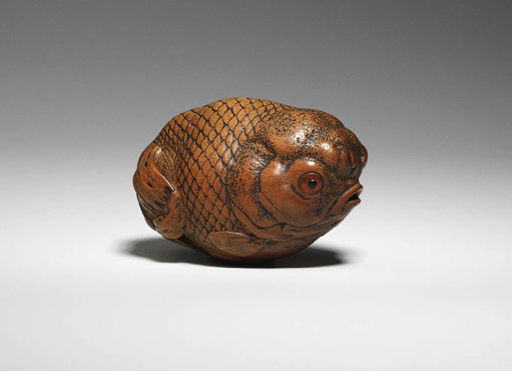
Nestuke—so we learned (so many of you must know)—are small, sculptural objects made of porcelain, ivory, wood, boar tusk or stone that were traditionally designed to prevent one’s purse from slipping through the belt or obi worn over one’s kimono. Both functional and aesthetic, netsuke were commonly designed after people, plants, and animals, after gods and religious symbols, after folkloric figures and mythological beasts. 


The netsuke we found in the shoe boxes that summer left us speechless for their strangeness and variety, as well as for their extraordinary workmanship and beauty—charms, tokens, of a long-gone, bygone age. Purchased by the owner of the house from the many desperate Japanese she had met in Tokyo and Yokohama immediately following the war, men and women often on the verge of starvation and madness, she’d collected the netsuke in the shoe boxes beneath her guestroom beds for close to a decade, originally knowing little or nothing about their function or worth. Was it kindness or simple opportunism that had motivated her to buy them, these extraordinary artifacts? We didn’t know; not having met her before, we couldn’t even guess. Only later, in a follow-up letter that same summer, when she’d nearly recovered and was planning her return, did we learn that, years before, and whatever her initial motive for buying them, she had willed the entire collection of netsuke, appraised at over a million dollars, back to the nation of Japan, to the country and people she loved. It is something Hearn himself would have done.


Of course Hearn (the writer and ethnographer, the avid devotee) made his own fine bequest to the Japanese people—his nearly countless essays and observations about a Japan now largely vanished beneath the flash and clamor of the modern world, so that today the Japanese themselves rely on his writings to revisit and remember who they were and what they valued, to reacquaint themselves with their once-singular customs and ways. 

Surely one of my favorite passages from this collection of essays, one I’d like to leave you with, is Hearn’s awestruck description of a legendary sea-cave near Matsue, which he had heard about upon his arrival in the city and had hoped dearly to see:

Few pilgrims go thither there by sea, and boatmen are forbidden to go there if there be even enough wind ’to move three hairs.’ So that whoever wishes to visit Kaka must either wait for a period of dead calm—very rare upon the coast of the Japanese Sea—or journey thereunto by land; and by land the way is difficult and wearisome. But I must see Kaka. For at Kaka, in a great cavern by the sea, there is a famous Jizō of stone; and each night, it is said, the ghosts of little children climb to the high cavern and pile up before the statue small heaps of pebbles; and every morning, in the soft sand, there may be seen the fresh prints of tiny naked feet, the feet of the infant ghosts. It is also said that in the cavern there is a rock out of which comes a stream of milk, as from a woman’s breast; and the white stream flows forever, and the phantom children drink of it. Pilgrims bring with them gifts of straw sandals—the zori that children wear—and leave them before the cavern, that the feet of the little ghosts may not be wounded by the sharp rocks. And the pilgrim treads with caution, lest he should overturn any of the many heaps of stones; for if this be done the children cry.


Peter Adam Nash

Saturday, December 3, 2016

The Other World

The Brighter House, Kim Garcia

Bright Scythe, Tomas Tranströmer (trans. Patty Crane)


I was reading Tranströmer's Bright Scythe when Kim Garcia's The Brighter House arrived in the mail.  I have always enjoyed reading poets in tandem, looking for points of comparison--it's a way of concentrating that has enhanced my understanding of poets who are otherwise too difficult. Tranströmer, for example, sometimes eludes me:

Leaflet

The silent rage scribbles on the inward wall.
Fruit trees in bloom, the cuckoo calls out. 
This is spring's narcosis. But the silent rage
paints its slogans backwards in garages.

We see all and nothing, but straight as periscopes
handled by the underworld's timid crew.
It's the war of minutes. The broiling sun
stands over the hospital, suffering's parking lot.

We the living nails hammered down in society!
One day we'll come loose from everything.
We'll feel death's air under our wings
and be milder and wilder than we are here. 

A couple of years of Old English allow me to make out a word here and there, enough to see that Patty Crane has followed the poet's intentions closely--"hanterade av underjordens skygga besattning"--aside from the syntax, this is the line, word for word. So what is Tranströmer up to here and in poems like "Ljuset Strommar In" ("Light Streams In") that end with this typical apocalyptic twist: "The countdown has begun."  Or "Winter's Glance" with its "Then suddenly I'm struck by a chill from far away./The moment darkens/and remains like an ax scare on a trunk." One doesn't expect Swedish poets to offer sun-drenched, Mediterranean imagery. I know Kierkegaard was Danish, but I can't help but think of SK when reading something like "An icy wind in my eyes and the suns dance/inside a kaleidoscope of tears..." ("The Crossing Place").  The theology of dimly-lit churches, pale Calvinism, black trees, blowing snow, the way I felt when I first watched "Persona"--dazzled by my incomprehension of what Bergman was about.

But then Tranströmer also writes poems that are as transparent as an icy window: "We are the earth," he writes in "Sketch in October," yes, of course. Or the beautiful poem "The Station," a simple series of declarative statements that end with the injunction to "remember this" moment of clarity, the man hitting the wheels of the train with a maul, a "round-the-world sound/that lifts the whole train and the regions wet stone." ("varldsomseglarklang").  But with these poems one must think of a parallel world, a magic world where every simple thing is made simpler, where the poet sees through objects and events, into the heart of things. "The sun lies low now./Our shadows are goliaths./Soon shadow is all." What seems mysterious is what we don't attend to. Tranströmer writes fairy tales, poems of revelation that are, despite the rich imagery, primarily about ideas. Bergman might not be a bad comparison, but Tranströmer is lighter on his feet, never morose--yes there are lots of shadows to be found, but they aren't emblems for existential emptiness--the sun is going down, that's all. 


Kim Garcia's The Brighter House uses Tranströmer's prose poem "Madrigal" as an epigram: "I inherited a dark forest where I seldom walk. But there will come a day when the dead and the living change places." 

Garcia writes poems that are unique, but call to mind some of Tranströmer's penchant for fairy tales--here's Garcia:

In My City of Z, Forgiveness

In the City of Z. I was scarred--three lines, sternum to solar plexus.
They wept and festered and would not heal. How else can you be beautiful?
asked the angels of that place. I had hope for something more

than my own body handed back to me, still barren, still bargaining.
My mouth was stuffed with manioc. My belly gave up its worms,
still I would not abandon the pictures hope twisted from my dreams.

They threatened to crush my skull, to feed me to the fish. I pressed
small children for a word of the world in the other country, a physics
of speech not equal but opposite. So they teased me with nonsense,

birdsong, their own alliterative names made strange by my longing
to speak strange, be strange, all at once familiar, while my abdomen
bloomed--egg-laying insects, boring to blood, unhinging the last bone.

I kept a final word under my tongue, belligerent child. Shook my head.
I didn't want to. Wouldn't. Not even silence could enter my lips, gentle
as she was. I had paid my way cross-river. I had to be worth something. 

***

I won't mention Tranströmer again, as this is a consideration of Kim Garcia, but keeping the two volumes side-by-side on my desk, making notes in each one, comparing lines and poems is instructive--not only did I read the Swede with greater clarity, I understood, I think, what Ms. Garcia had set out to do.

Garcia's poems are mythical in content and subject matter ("And in the beginning was all the after," "Thor," "Miracle," "Rumpelstiltskin," etc.), that is, they aspire to locate the unchanging in the everyday, or work in the opposite direction by finding the quotidian in the mythical ("The Little Golden Books," especially "The Toad Princess"). In many cases, the crossing over from the realm of feeling to thought involves violence or violation. Indeed, The Brighter House is full of images of blood and violence in something like the way Transtromer's poems are packed with images of death. How else can one be born or reborn but in blood--I was wondering about religious influences in the two poets, Garcia's fleshy Catholic icons and Transtromer's rather more bloodless (but far more somber) Protestantism--well, I can't claim much for this line of thought since I know nothing about the poets' backgrounds or beliefs. 

In both poets' work I felt the urge to tear away the illusions of simple perception--there is always something else that we are called upon to attend to...as in "the mystic crucifixion by Tintoretto," a poem about doubling experience, hiding one meaning inside another. Isn't this what fairy tales do, what magic is about, what the best poetry is up to? Not in the trivial sense of direct reference to another meaning, but in the subtle way that a good poem is read with both with the consciousness of what it says and the sense that it is also saying something else--you need to pay attention--but still something important remains elusive. A mystery, or a Mystery--glorious, sorrowful. Yes, this thought occurred to me more than once as I read Garcia--she was inviting me to do a little extra work: "I was, as you said, very strange/ Pale and larval, like something flayed." Not a line I'll soon forget. ("Unicorn and Virgin: Cloisters Tapestries"). This one feels like a prayer. Others feel like magical invocations, talismans ("You're All the Gods to Me"). Or, "Oil." This one walked around with me for a full day, like a melodic line from Miles's "Autumn Leaves,"my favorite November record--"And death never caught me, / easy as I was to catch."

Garcia has a fine sense of the twists and turns of feeling, of fear especially, but also of affection--here's a few examples from The Brighter House of her fetching ability to catch us up in her world: "The weight of the water at the bottom of the sea crushes the air out of/our bone. It is a desert, an endless overabundance of just one thing." ("Tales of the Sisters: Atlantis)--I love the simplicity of "just one thing," an anti-climax after the forbidding crushing of the air out of our bones.  "So awkwardly arranged that she must walk with one hand extended/like the blind, anticipating touch in a world full of surface" this is brilliant, but it gets better: "balancing a bucket of lake water half as heavy as she is, a strange S curve/in the spine, torqued." That last word: it snaps the line and reader to attention: the miraculous girl weighted down, bent, reaching ahead to feel the air like a blind person, torqued. ("Miracle"). Such a simple act, a little story of fish head and a racoon, but Garcia, mythographer, turns the whole into something richer, an illusion, a miracle. I enjoy the idea of seeing life constantly brushing up against the surreal, the unreal, the miraculous: 

Early Morning

As though my lover placed his cold, chapped hand
against the soft tissue under my ribs, stopping my breath.

As though that silence were in incision
I could step through. [!] Foot-lifted, hand in the flame.

Or as though we were sparrows hopping on the garage roof,
the trees dripping, piercing the gray with silver needles.

A pink magnolia holding up palm after palm of blessing.

One could write "My lover..." "That silence," "We were," but the speculative tone created by "as though" evokes a meditative mood, as if the poet were asking herself what this moment of early morning was like...is it this, or that? All of those things, and none of them--and Garcia knows enough not to ruin the mood by pinning anything down; best of all, the vivid image at the end. You've seen it, the magnolia leaves rustling like palms (of hands, of Palm Sunday, the ambiguity of the palms strewn before Jesus as he entered Jerusalem for the last time--a blessing with menace). 

Well, that's what poetry does. Words strewn about don't make a poem, nor does prose clipped into stanzas. There has to be a sensibility at work, but not only that, a sensibility whose intimacy isn't only with the world or with language, but with both at once. Too much poetry that I read is simple code, autobiography disguised with imagery and inference. The best poetry (my opinion) feels unaffected, comes to us as a consistent way of seeing and feeling, one that we don't merely observe, but share. The language of creation. 

From an earlier collection: one of my favorite poems:

Transport

Between twilight and twilight the muddle-sleep of fear
with a head against a stranger's shoulder. Every bomb
every bullet is coming towards you, every hand holding
a detonator. A jolt in the road, and it's all over. Where am I?
A battlefield is home compared to that place. Then, it's day.

A buddy is sprawled on the bench seat, mouth raw, agape.
Tenderness. Maybe bombs are outside waiting, but here
a bit of morning comes through dirt-smudged windows.
The driver swigs coffee from a flask. He's driven all night
while you slept helpless. A flood of thanks, before thinking,

at the back of his head. The windshield is full of blue sky.
The drones will be out, Bethlehem stars, clearing the way.
You let the thanking in, the melt where fear was, blood warm.
Give into it, like you give into the truck’s shake through
your bones, like whiskey. Let it soak your parched ground.  


 George Ovitt (12/3/2016)

Kim Garcia's award-winning The Brighter House is available from White Pine Press--their link is on this page.

Bright Scythe is available from Sarabande Books, Louisville, Kentucky, here:
http://www.sarabandebooks.org/catalogs/


Monday, November 21, 2016

The Poetry of Great Prose


I believe in the magic and authority of words.

                               René Char

“You want to write great fiction? Then read poetry.” It’s what I tell young writers all the time. Surely such late great novelists as Joseph Conrad, Marcel Proust,  Virginia Woolf, and James Joyce spent many a patient hour at the feet of their favorite poets. Only glance at their fiction and see. Read the opening pages of Heart of Darkness, of In Search of Lost Time, of To the Lighthouse, and try (just try!) to restrain your admiration, your awe. Read but the last few paragraphs of Joyce’s short story "The Dead” and you’ll be struck at once by the genius and poetry of this complex, this revolutionary, this beautiful prose.  

Of course it makes sense: literary modernism—the movement within which the language of each of these writers was forged—was distinguished, above all, by the patent, if sometimes tacit, determination to elevate the lowly novel as a form to the time-honored status of poetry. And how did these writers achieve this? By making their prose more expressly poetic, by coopting and adapting for the novel and short story many of the conventions by which poetry as an art was best known. Of these many and venerable traits, perhaps the one these writers found most appealing was the dense, allusive, often highly symbolic nature of the language itself. No longer would their prose be just the invisible cousin to plot and character and theme, the wire by which the current was carried to the bulb, but would boldly take its place beside them in the tale, regularly calling attention to its charms, sometimes—drunk with wonder at itself—even obscuring what happens and to whom (see Molloy and Malone Dies, see Ulysses, see Finnegan’s Wake)! 
  
Rita Dove once said that “Poetry is language at its most distilled and most powerful.” It is an idea affirmed by poet Frances Mayes in her remarkable introduction to the reading, appreciation, and writing of poetry, The Discovery of Poetry. Again and again she insists that poetry is the language art for the way it teaches us about the often simple words we use each day, restoring weight and consequence to our expression, to our every verb and noun, to our every comma and period and dash. Good writing is deliberate writing; it is language under pressure—a fact well known to poets. Indeed arguably no writers put more pressure on their language than poets, toiling daily with the challenge of capturing the obvious and the ineffable, with “the naming of things into their things.” Poets are nothing if not meticulous, obsessive, precise. Writes Edward Arlington Robinson, “This morning I deleted the hyphen from ‘hell-hound’ and made it one word; this afternoon I redivided it and restored the hyphen.”

Crazy? I don’t think so. It’s what poets do, restlessly reinventing our language for us (its glory, its purpose, its pitfalls, its might) and by extension our very sense of ourselves—as people, as human beings. As much as ever now we are our words, our poets (and the novelists who revere them) the subtle crafters of our being, our fate. Writes the great modernist, T.S. Eliot, “For last years’ words belong to last years’ language/And next year’s words await another voice.” 


Here again are some of my favorite novelists—each of them steeped in poetry—who have answered Eliot’s call: Lowry, Barnes, Cela, Ellison, Castellanos, Bellow, Qian, Saramago, Camus, Carpentier, Oe, Böll, Dorfman, Niwa, Voinovich, Manea, Ishiguro, Rushdie, Gordimer, Saghal, Jin, Brink, Malamud, Cortázar, Gao, McCarthy, Styron, Amado, Pamuk, Vargas Llosa, Jelinek, Klíma, Stein, Wright, Grossman, Mistry, Gombrowicz, Lispector, Morrison, Sabato, Silko, Pavese, Coetzee, Nabakov, Kahout, Olesha, Oz, Levi, Okri, Appelfeld, Bernhard, Platanov, Farah, Aksyonov, Fuentes, Bolaño, Ulitskaya, Emecheta, Sebald, Unsworth, Martin, Trevor, Erdrich, Kaniuk, Petry, Naipaul, Szabó, Hong, Chacel, Borges, Bowles, Yehoshua, Sōseki, Tišma, Walser, Ford, Head, Green, Duffy, Abish, Cohen, Ghalem, Agnon, Baldwin, Handke, Ivo, Rulfo, Benet, Mahfouz, Ali, Megged, Murdoch, Hrabal, Novakovich, Bowen, Houllebecq, Ocampo, Zhang, Rodoreda, Asturias, Sábato, Soyinka, Müller, Fox, White, Adler, Vollmann, Ford, Lenz, Márquez, Platonov, Toer, Narayan, Schulze, Carey, Wallace, Bedford, Ying, Nooteboom, Achebe, Arenas, Desai, Páral, Énard, Lamming, Robbe-Grillet, Kraznahorkai, Machado de Assis, Del Paso, and Gass.

Peter Adam Nash

Sunday, November 13, 2016

Kafkaesque

Roberto Calasso, K

"If I go away, I told myself, sitting in the iron chair, I shall only be going away from a country in which I no longer have any place and in which I have never found happiness. If I go away, I shall be going from a country in which the towns stink and the inhabitants of the towns have become coarsened. I shall be going away from a country, I told myself in the iron chair, in which the only model of behaviour is set by the so-called wild animals."  --Thomas Bernhard, Concrete


This past week, I would imagine, has seen record sales for books like Concrete and The Castle. There are plenty of fine books that take politics as their subject, but there aren't many serious books that are as funny as Kafka's, and no one writes witty monologues like Bernhard. Books, in other words, that provide not so much distraction as direction. 

In a lovely essay published as part of his collection Consider the Lobster, David Foster Wallace writes about Kafka's strange wit: 

"What Kafka's stories have, rather, is a grotesque, gorgeous, and thoroughly modern complexity, an ambivalence that becomes the multivalent Both/And logic of the, quote, 'unconscious,' which I personally think is just a fancy word for 'soul.' Kafka's humor--not only not neurotic but anti-neurotic, heroically sane--is, finally, a religious humor, but religious in the manner of Kierkegaard and Rilk and the Psalms, a harrowing spirituality against which even Ms. [Flannery] O'Connor's bloody grace seems a little bit easy, the souls at stake pre-made."

This isn't an easy reading of Kafka, but I think I understand what Wallace meant. There is a laughter of mockery and of mere wit, but the laughter of recognition is the most profound, and the most difficult to provoke. What can you do when you see the bare, unvarnished truth but laugh? And this isn't the chuckle of pleasure or the belly laugh of a tickled funny bone, but the uneasy "oh, yeah, right" that comes to us by surprise, and, at times, painfully, when clarity illuminates some dark corner of life.  Like: K. won't set foot in the Castle and everything he has believed about himself, his calling, has been false, or misunderstood. 

This past week I heard the word "gobsmacked" a few times. As in smacking one's hand against one's mouth in surprise. K., however, seems forever phlegmatic, and appears to take surprise in stride, which is, in itself, funny:

"You should know by now that the question of your being called here is too difficult for us to answer for you in the course of one little conversation," the Superintendent tells K. when the latter inquires about his (mythic) "position" as surveyor at the Castle.

Calasso notes that "All of life is no more than 'a little conversation.' And so the principle of the irrepressible uncertainty of election is once again affirmed." 

Perfect. Kafka makes us laugh, uneasily, because his stories remind us again and again of the continual, confounding, irrepressibility of uncertainty in our lives. What we think we know we don't know, and while we are trying to find out what we do know we pass our time in the Inn, waiting. Callasso reminds us that, in Kafka's world, "Nothing is more dangerous--we must understand--than everyday life. There, even when performing the most casual, inconsequential acts, we must remember we are constantly under surveillance. We must watch our every step, looking in all directions, as if under siege." Like Joseph K., we are "building our case," that is proving we are innocent of charges that are unclear to us and to our accusers as well. 

This is, I think, what Wallace means when he speaks of the religious nature of Kafka's wit. What is harrowing is not knowing what to do, or what we have done, facing the dangers of everyday life without any notion of what happens next. This is metaphysical uncertainty because we are powerless and must trust, therefore, in something, or in someone else. If not God--and definitely not God--then in history, or reason, or humanity. "Not a comforting prospect these days," I laughed, uneasily, sitting in my desk chair.


 George Ovitt (11/13/16)


Tuesday, November 1, 2016

Unicuique suum


To Each His Own by Leonardo Sciascia

I have never been fond of thrillers, which tend to make me feel like a puppet on strings. The artifice, the manipulation, is too much for me, too conspicuous, too plain; it is often all (what little) I see. What makes reading such popular fiction so difficult for me, so unsatisfactory, so discouraging finally, is that, much like video, it is generally constructed in such a way as to merely tell you—rather than show you—a tale. By its nature, it asks very little of you, the reader, but that you be passive and receive. It imposes rather than supposes.  

A literary agent who specializes in ‘literary fiction’ recently replied to a query of mine (I’d sent her the opening pages of a novel I’d written) by chiding me, “I hope you’re not one of those writers who think that plot is secondary.” It was everything I could do not to respond, “No, I am not one of those writers. To me, plot isn’t even a tertiary concern.” It would not have been an exaggeration. F. Scott Fitzgerald famously wrote, “Character is plot, plot is character.” It is what I too believe, that literature is first and foremost the study of character, of what it means to be human, of what it is (may it never be discovered) that makes us tick. Reading literary fiction is nothing if not the expression of a deep-seeded desire to know others, to be less lonely, to see ourselves more truly. It is about confronting—again and again—what Neruda calls “the confused impurity of the human condition.”

Yet there is more to literary fiction than that. Now more than ever, it is also, and essentially, about empowerment and agency in an increasingly coercive,  increasingly anti-democratic world, a blooming corporate sovereignty that depends more on servility and conformity and consumption than on freedom and dignity, on courage and struggle and change. The sort of fiction I live to read (the sort of fiction TR founder George Ovitt and I have extolled for years on this blog—see again his post on The Grapes of Wrath) is that which not only invites me to participate in it, in the active construction of its meaning, its value, but actually requires it, indeed is incomplete, impossible, without me, without my intelligence, my commitment, however uncertain and imperfect they may be. Reading literary fiction is one of the great, time-tested ways of training the heart and mind to participate wholly, urgently, in the world about us, to question and resist, to engage bravely and meaningfully with others. Great fiction doesn’t simplify life but complicates it. It must—or it deceives. 

All of which is to say what? All of which is to say how strangely pleasant it was to read Sicilian author Leonardo Sciascia’s perhaps best known detective thriller, To Each His Own. It surprised me at every turn—its lack of gimmickry, its depth of character, and its language itself, not to mention its brooding, ultimately fatalistic critique of the codes and culture of Sicily, the author’s own home and hell. Philip Hensher puts it best: “Some of [Sciascia’s] books, like the brilliant To Each His Own, look like bleak, inclusive thrillers, and slowly turn into grand indictments of the abuse of power. They are all very different books, united by a ruthless, unsparing gaze, and common subject in power and its abuses.”

To each his own. Yes. To each (and everyone) her own.


Peter Adam Nash

Sunday, October 23, 2016

The Moral American

John Steinbeck, The Grapes of Wrath

Alasdair MacIntyre, After Virtue


Let's be honest: from the beginning, everything has been arranged in such a way that Florence Thompson would one day sit in a makeshift shelter, bone-tired and hungry, nursing her daughter in a muddy field near Nipomo Mesa, off Hightway 101 outside of Watsonville, California. She and her family were lucky to find work picking peas on that day:

  The older man laughed and looked at the boy, and his silent son grinned almost in triumph. And the man said, "You ain't gonna get no steady work. Gonna scrabble for your dinner ever' day. An' you gonna do her with people lookin' mean at you,...."
  Pa asked slowly, "Ain't--ain't it nice out there at all?"
  "Sure, nice to look at, but you can't have none of it." (Grapes of Wrath, 280-281)

You can't have none of it. 

James Madison patiently explained to men just like himself  that a civic-minded elite would filter the fractious viewpoints of the mob for the good of all concerned; President Adams, in the heat of his struggles with Jefferson, passed a law that made it a crime to criticize the government. The Secretary of the Treasury pushed a bill through Congress that taxed the farmers of the Ohio Valley, and when they protested the General-President personally commanded an army to straighten them out. A few years later the Supreme Court established that--republic be damned--the Court would do the deciding...and they did, always in favor of the Land company that made sure that the Thompson's and the Joad's and Wilson's would be the ones sitting in the tent begging for work and not them.


John Steinbeck's masterpiece, an American classic worth reading once a decade, turns the Founders' "mob" into a family--not just the Joad family, but the family of the dispossessed, the family of the wretched of the earth.  Read in conjunction with James Agee's and Walker Evan's Let Us Now Praise Famous Men ("and the fathers who begot us," Sirach, 44:1) and a collection of Dorothea Lange's dust-bowl photographs, Grapes of Wrath is that rarest of literary creations--a truly subversive book that even (sometimes!) shows up on high school reading lists. Steinbeck is scathing on the subject of corporate monopolies, government ineptitude, law enforcement's bias toward the wealthy, and, even toward capitalism itself. His alternating chapters--one of documentary social criticism paired with one telling the story of the Joad's economic and moral odyssey--serve up both an intellectual and emotional critique of an economic system that rewards the few who don't work (one landowner has "a million acres"--"What in the worl' can he do with a million acres?" "I dunno. He jus' got it.") and ignores or punishes the many who do.

I've been reading Grapes of Wrath in conjunction with the latest American election cycle, watching sadly as the one-percent squabbles over the corpse (as it were). At the same time I dipped back into Alasdair MacIntyre's After Virtue, one of the finest books ever written on the subject of doing well, living morally, in a world where the notion of morality has been reduced to a set of preferences. MacIntyre's argument is that modern (post-Kantian, post-Nietzschean) moral philosophy is stuck between utilitarianism and emotivism--the empty notion of a "greatest good" as measured by bureaucracies and the equally empty notion of a personal good defined by individual tastes. Either way, in MacIntyre's view, we are left with no means of making moral choices; we are left without virtue (a terribly old-fashioned word nowadays).


MacIntyre is more persuasive in this dismantling of the hollowness of preferential ethics than in his remedies: he's a Roman Catholic who finds solace in the clarity and moral absolutes of Aquinas and Aristotle. My problem with Aristotle is that he too posits a formulaic morality based on preference--what's the difference between an emotivist's choice of what feels right and an Aristotelian's choice of what constitutes the mean (not, by the way, the same as Buddhism's "middle path," since the Buddha clearly establishes what the eight fundamental human qualities are, and each of them is amenable to simple moderation; Aristotle's virtues in some cases actually preclude moderation).  And with Aquinas, well, you must have God, and not just any God--it must be the providential one, the one constantly invoked by the sort of people who always tend to hear God telling them to do just what they'd do anyway. No thanks.

But MacIntyre does have one very rich idea, and it takes us right back to the Joad's and their wandering in the desert of endemic American rural poverty. Here's MacIntyre:

"In Latin, as in ancient Greek, there is no word correctly translated by our work 'moral,' or rather there is no such word until our word 'moral' is translated back into Latin.....But 'moralis,' like its Greek predecessor 'ethikos'....means 'pertaining to character' where a [person's] character is nothing other than his or her dispositions to behave systematically in one way rather than another, to lead one particular kind of life." [After Virtue, 2nd ed., 18] [my emphasis]

Here's a thought: instead of thinking about morality (one's character) or ethics (one's choices) as an unfolding process of difficult decisions made throughout a life--as a dangerous dodging of temptations, as a negotiation among sometimes equally unpleasant decisions, as the courtroom of conscience--let's think of morality and ethics together as character, as a disposition to act in certain ways that is prior to and which subsumes any particular choices. Too often morals are thought to be forged in the battleground of living an adult life, but what we now know about the moral growth of children suggests that by the time we get to make choices, it's already likely that we'll make them according to our character.  And where does character come from? Not, as we are prone to think, from individual preferences or calculations about what is good for us and others, but from our social relations, from our adaptation to the demands of families, friends, lovers, communities--from intimate daily interactions with the people around us. MacIntyre wants something like an essential character, a nub of goodness and virtue that we can refer to when we make choices. Well, we have that, but it doesn't come into existence through rational calculation in the Aristotelian or Kantian sense.


I can't not see Jane Barwell as Ma Joad when I read Grapes. For me, she is the moral center of the novel, the proof of Steinbeck's generous reading of the power of a large, if unsophisticated, human soul.  Ma is often speechless, often "intuitive" in her decisions. One of the greatest scenes of the novel comes when, having just arrived in California, Granma lies dying in the tent, whimpering in pain and loss (separation from one's place kills off the older generation). Ma and Rose of Sharon are tending to the old woman when a police officer pushes, uninvited, into the tent to ask Ma when she will be living the miserable camp where the Joad's are resting:

"Who's in here," [the policeman] demanded again.
"Ma asked, "What is it you want, mister?"
"What you think I want? I want to know who's in here."
"Why, they's jus' us three in here. Me an' Granma an' my girl."
...
"Where'd you come from?"
"Right near Sallisaw, Oklahoma."
"Well, you can't stay here."
"We aim to get out tonight an' cross the desert mister."
"Well you better. If you're here tomorra this time I'll run you in. We don't want none of you settlin' down here."
Ma's face blackened with anger. She got slowly to her feet, she stooped to the utensil box and picked out the iron skillet. "Mister," she said, "you got a tin button an' a gun. Where I come from, you keep your voice down."
...
"Well you ain't in your country now. You're in California, an' we don't want you goddamn Okies settlin' down."
Ma's advance stopped. She looked puzzled. "Okies?" she said softly. "Okies."

Note: first a question...then a puzzled statement. How best to diminish personhood and therefore rights?  Turn someone into a "terrorist" or an "immigrant" or an "Okie."

Ma Joad doesn't invoke the rules of privacy or her legal rights; she tells the cop to watch his tongue. Strangers, badge or no, haven't any right to speak rudely--"where I come from"--the spirit of place is invoked to support a moral norm, and the place isn't only Sallisaw, Oklahoma, but a place where mutuality and respect demand certain kinds of behavior. We see Ma throughout the novel as the judge of what is right and wrong--will the preacher be allowed to come along, even though he isn't family; should the holy lady speak a blessing over Granma? In every case, the foundation of Ma's judgments is based on what MacIntyre refers to as "character," a way of living one's life that is so deeply ingrained that moral choices aren't forms of problem solving--measuring behavior to an eternal standard--but simply getting on with one's life by doing what is right.  Of course we don't raise our voice, refer to people as "Okies," threaten women and children--no decent person would.

Grapes of Wrath has about it both the power of a political tract and the refinement of a meditation on morality. In scene after scene, from the sociological analysis of bureaucratic power in Chapter Five to Tom's beautiful "I'll be ever'where--wherever you look" speech at the novel's end, Steinbeck examines the confrontation of simple humanity with overweening power. Mostly, of course,  simple humanity is no match for drought, tractors, bankers, and sheriffs. In that regard, nothing much has changed. But Steinbeck stretched the possibilities of the American novel by examining the moral lives of the poorest among us, and by dissecting the mechanical nature of power, forced his readers to see how power strips even decent people of the ability to act kindly toward their neighbors.


So Florence Thompson sat in her tent and nursed her child. She still does. Not Florence, and not a tent. More like a jail cell these days. If Steinbeck were around, he'd write about it.


George Ovitt (10/23/16)

References are to the handy Penguin PB, in print since the 70's. The original appeared in 1939


Monday, October 17, 2016

Where the Light Enters You

“Love” by Clarice Lispector

There are times, when one has dropped one’s guard, that the world slips in through the cracks. Staggered suddenly, we are overwhelmed by the pain and suffering about us. We see it as if for the first time—gaudy, garish, profane. It incriminates us; it makes us feel angry and helpless; it shakes our convictions, our certainties; it fills us with longing, with dread. The triggers vary—a song, an illness, a blind man chewing gum. Even everyday exhaustion does the trick. Yet for most of us such occasions, such flashes of insight, are woefully rare. By the time we are adults we’ve become so adept at keeping the world and its agonies at bay that we are hardly aware we are doing it—and with such vigilance, such energy, reflexively numbing (with video, with drugs and alcohol, with the daily violence of routine), if not blocking altogether, those precious sensors in our brains that allow us to sympathize, even to empathize, with the people around us, to feel this life truly, to see and sense it as it is.  

W. H. Auden, in his famous poem “Musée des Beaux Arts,” writes,

About human suffering they were never wrong,
The Old Masters; how well, they understood
Its human position; how it takes place
While someone else is eating or opening a window or just walking dully along…

These lines might very well have been the prompt, the inspiration, for Brazilian author Clarice Lispector’s astonishingly trenchant short story, “Love”. While not an Old Master, she was certainly a Modern One, a writer with an exquisitely refined sense of the pain and anguish of others. The premise of the story is simple: a relatively happy, self-satisfied housewife is on her way home from buying groceries when she spots a blind man from the window of the tram, a grim, if normally prosaic detail that somehow penetrates her defenses and shakes her to her core. Suddenly the safe, cozy bubble she has made of her life is burst. She puzzles,

But what else was there about him that made Anna sit up in distrust? Something disquieting was happening. Then she discovered what it was: the blind man was chewing gum…a blind man chewing gum. Anna still had time to reflect for a second that her brothers were coming to dinner—her heart pounding at regular intervals. Leaning forward, she studied the blind man intently, as one observes something incapable of returning our gaze. Relaxed, and with open eyes, he was chewing gum in the failing light. The facial movements of his chewing made him appear to smile then suddenly stop smiling, to smile and stop smiling. Anna stared at him as if he had insulted her. And anyone watching would have received the impression  of a woman filled with hatred… A second signal from the conductor and the tram moved off with another jerk… The tram was rattling on the rails and the blind man chewing gum had remained behind for ever. But the damage had been done.

The story itself is like the blind man chewing gum; it is a perfect example of what art does best, interrupting the expected narrative of our daily lives, giving us pause, even stopping us dead in our tracks. Rumi once said that “The wound is the place where the Light enters you.” Of course the ‘wound’ he speaks of is what all great literature is about—making us vulnerable to others, keeping us susceptible to the world in which we live.

“Love” is one of the many remarkable stories included in the collection, Clarice Lispector: Complete Stories, published by New Directions.


Peter Adam Nash

Sunday, October 9, 2016

Wit

The House on Boulevard St. (New and Selected Poems), David Kirby

Some Jazz a While (Collected Poems), Miller Williams


The Year They Outlawed Baseball

The year they outlawed baseball
nobody played.
The next year people said
how it used to be,
the center fielder leaping up the wall.
The next year a few men tossed a few
in backyards and basements
without the gloves.
The ball gives off a sound
hitting the leather
anyone around could recognize.
Still people talked
and that was the end of that.
For years the widows kept scarred and lopsided balls
on the top shelves of closets in back rooms
and thought of showing them to trusted friends.

--Miller Williams


Wit, in English, was an invention of the 16th century. The Romans had it too, but these days only a classicist gets their jokes. Englishmen read Horace, made a few translations, then struck out on their own. Smart people are witty, or can be; less smart people are funny; the unsmart tend to mistake vulgarity for humor. And so on down the line until you get to sit-coms that only machines find amusing.

We know that Ben Jonson had wit; Shakespeare did too, in spades, and all of those great metaphysical poets you may have read in college and forgotten. Remember John Donne's "The Flea"?  Or those double entendres that fill Shakespeare's woodsy comedies?

All of the definitions, as well as the etymology of the word, link wit to both humor and intelligence, "a pleasing aptitude for using language in such a way as to make both intelligent and humorous commentary on the human condition" is my own formulation, based on half-a-dozen respectable sources. I note, without surprise, that the use of the word "wit" has declined precipitously over the past century--soon, I imagine, "wit" will join "civility," "dapper," (a word I love), "urbane," and "sophisticated" on the scrap heap of linguistic history. After all, though we are quite comfortable using words that no longer have any meaning--"truth" for example--at a certain point the jig is up: no referent, no word. And where, I wonder, do we look for wit nowadays? In our poets and hardcore troubadours, where else? Those anachronistic beings who labor to keep the language rich in the face of its diminution.


"In the days after my first marriage collapsed, I thought
              Virtue is gone, in the words of old Sir John Mandeville,
the Clergie is in error, the Devil reigneth, Simonie beareth away,
                                          Suicide carrieth off many, and Drink taketh the rest,
one of whom was me--I was sleeping single
            and drinking doubles, oh year, for I didn't have a clue about love,

not one, only the youthful example of my parents
              and my pre-teen foray into the world of beefcake magazines,
of Grecian Pictorial, MANual, and Trim
                                   with their smiling sailors face down on beachtowels,
their Italian teenagers in posing pouches leaning against
          fake Roman walls, their latter day Houdinis in baby oil and chains....

--David Kirby, from the title poem of his New and Selected Poems

There's no "typical" David Kirby poem, except in his use of saw-toothed margins, moments of seeming gravity ("my first marriage collapsed") followed at once by wry forays into tangential scholarship ("old Sir John Mandeville"...old indeed!), utterly arcane cultural citations (when was the last time you saw the word "beefcake" in a poem?), self-mockery (a consistent feature, varying only in degrees of savagery and affection). I wish I had the patience to type out this or any other Kirby poem in its entirety--they're all a hundred or more lines long, meandering through the inner world of the author as he confronts life's little oddities, like attending the funeral of someone he didn't know ("At the Grave of Harold Goldstein") or noticing a dog with a lampshade around its neck while eating--that is while Kirby eats--a patelito ("Winter Dance Party"). The opening lines of many Kirby poems are like the opening quips of one of the older generation of great stand-up comics--a Bob Newhart, a Shelly Berman, or a Milton Berle rather than like one of those contemporary vulgarians like...you know who they are.

[Aside: I can't help it: though he is certainly much better read (without flaunting it) and is much younger, Kirby's self-doubting inner voice constantly reminds me of Newhart, my favorite neurotic funny man. Those old comics did neurosis well--Rodney Dangerfield and Phyllis Diller, or, going back a little, Jack Benny on radio. And if not neurosis, then harmless craziness as with Jonathan Winters and his star pupil, Robin "Mork" Williams].

Here's Kirby--almost an opening monologue:

 "'Enchantee!' says Mrs. Huntington, extending her hand,
                              which I take, my jaw dropping onto my chest
and my brain going into gridlock
                as I tell myself, Think, Kirby, say something,
anything, but I'm just standing there like an idiot...."

Kirby's poems are loosely constructed, but structured; that is, they have a clearly recognizable form that is disguised by their shifts in tone and swings from formal to informal diction, as in this one, "The Ghost of Henry James," a wry meditation on Henry James and especially on Portrait of a Lady, quite a feat, given the high solemnity of almost all of James's work. Should poems make you laugh? Kirby's do, and in this as well as in the erudition, mingling of high and low diction, the rattling lines and off-beat subjects one can see the debt he has to Albert Goldbarth, perhaps our foremost poetic satirist. (See The Kitchen Sink, New and Selected Poems).


Kirby also writes prose books that amaze with their combination of deep reading, cultural savvy, total coolness and approachability. I recommend Ultra-Talk, with a very long subtitle that includes the names of Johnny Cash and Theresa of Avila. Who wouldn't want to have Kirby for a teacher?


Miller Williams mines slightly different poetic terrain. Where Kirby explores the idiosyncrasies of a Kirby-persona in a highly personal way, with a style that is perfectly suited to his off-beat subjects, Miller Williams is running around in the same world that you and I occupy. The style is quotidian, even bland--William Stafford with a rather more jaded view of the human comedy. Williams has the patient, avuncular tone of someone who has seen it all and decided that wry humor is a better deflector of stupidity than bitterness or cynicism.

One of Those Rare Occurrences on a City Bus

For exactly sixty seconds riding to work
approaching a traffic light going to green
he understands everything. I mean from the outer
curling edge of the universe to quarks,
the white geometries of time, of language,
death and God, the potted plants of love.
He sits there and looks at the truth. He laughs.
What could we want, except for him to laugh?
Understanding all, he understands
he has only sixty seconds, then he returns
to live with us in ignorance again,
and little enough to laugh at. "Do you have a pen,"
he says to the man beside him,
"that I could use?" The man pats his pockets
and shakes his head and shows his open palms
to say that he is sorry. Fifty-three. Fifty-four.

Not a perfect poem--he might have stopped at line 12--but a good one, and typical of Williams's style and voice and world-view. Over and over he takes a look around and sees what we all see--violence and friendship and love and dying--and turns them over in his mind's eye, scrutinizes them, then offers them back to us clarified, intelligently parsed and wittily presented.  There's a searching, spiritual side to Williams, the sort of questioning attitude that reminds me of the metaphysicals. The wit of poems that say something like "Hell, I can't make sense of anything, but here it is, as I see it, and just to make sure I'm seeing aright, here are half-a-dozen things I've also seen that are sort of like this, but not quite." One of the reasons why the poems of Williams and Kirby are so chock-a-block with references and ideas is that making sense of things requires a mighty big tool kit. Any old problem can be torn to shreds with reason alone, but the witty poet understands that the point isn't to analyze the world, or to change it, but to grease it up enough so that it will fit into some sort of order that we have concocted for ourselves. Borges did this with his fictions, perhaps better than anyone else, and I can't think of any writer who matches Borges for wit in the classical sense--but that's the idea: not compiling irrelevant information but recognizing that you have to sort through a great deal of debris to find a way to fit the new fact into the world you inhabit.

Let's add this to our definition of wit: the willingness to directly address our failure to come up with a story that will convince anyone that we know what we're talking about. After all, what's funnier than ambiguity?

Hu's on first?


George Ovitt (10/9/16)

David Kirby is published by Louisiana State University Press; Miller Williams by University of Illinois Press